Get a Fence Installation Quote in Mansfield, TX: What to Ask and Red Flags to Watch
If your fence posts started leaning after a wet spring, or a backyard remodel just exposed an old fence line that will not survive another season, you are probably ready to get a fence installation quote. Here is the problem: most quotes you will see, online calculators included, assume a flat lot with cooperative soil. Mansfield does not have cooperative soil. North Texas clay swells when it rains and shrinks when it bakes, and that movement is the reason fence posts lean, gates sag, and concrete cracks around here. A fence quote that ignores your actual ground conditions is not a quote—it is a guess with a signature line. Understanding what fence quote red flags to watch for is essential before you commit to any contractor.
This guide walks through what a real fence quote should include, the questions that separate honest contractors from order-takers, and the red flags that tell you a number was built to win the job rather than build the fence. It is written for the homeowner who looks at their sloped yard and thinks, "I am not sure a regular wood fence will even hold up here." That skepticism is healthy. Keep it.
Why Mansfield Yards Break the Online Fence Calculator
Online cost calculators work from averages. According to HomeAdvisor, the average cost to install a fence is $23 per linear foot, with a typical range of $6 to $50 per linear foot depending on material and labor. That range is honest, but notice how wide it is. The difference between the bottom and the top of that range is mostly your site, not the pickets.
Mansfield sits on expansive clay. When seasonal moisture swings hit, that clay moves. It pushes on posts, heaves footings, and opens gaps under fence lines on slopes. Add hot summers that cook wood and vinyl finishes, occasional ice events, and heavy seasonal rain that runs downhill across sloped lots, and you have a set of conditions that national calculators never see.
For example, suppose a homeowner on a quarter-acre lot near a new pool install has a backyard that drops several feet from the house to the rear property line. A flat-lot quote might assume standard post holes and full prefab panels straight across. The real job might require stepped or racked panels to follow the slope, deeper post settings in clay, and attention to where water runs during a storm. Same linear footage, two different jobs, two different prices. In that scenario, the cheap quote is not a bargain. It is a fence that leans in three years.
This matters even more if your fence is tied to a larger project. If you are a pool or backyard remodeler, your fence has to meet pool code, coordinate with the patio contractor's grading, and look right next to new hardscape. A quote that does not account for any of that will balloon later, and the change orders will arrive at the worst possible time.
What a Complete Fence Quote Should Include
A real quote is a scope of work, not just a number. Before you compare prices from any fence company, make sure each bid actually describes the same fence. Two quotes that differ by a few thousand dollars often describe two different structures; one is built to last and one is built to be cheap on paper.
At minimum, a complete fence quote for fence installation should spell out:
- Material and grade. Not just "wood fence" but which wood. A cedar privacy fence behaves differently than budget pine. Vinyl fence quotes should name the product line. Concrete fence quotes should distinguish precast panels from poured work.
- Post type, spacing, and setting method. This is the line that matters most in clay soil. How deep do the posts go, what are they set in, and does the quote change if digging hits rock or dense clay?
- Fence height and style. A standard flat-top privacy fence costs less than board-on-board, shadow box, or horizontal designs. Those styles genuinely use more material and more labor, so they genuinely cost more. If one quote is for board-on-board and another is for a basic privacy fence, you are not comparing like to like.
- Gates, listed separately. Every gate is a stress point, and a driveway gate is its own small project. Gate installation should be itemized with hardware specified, because gates are the first thing to sag when posts move.
- Tear-out and haul-off. Removing an old fence and disposing of it is labor. Confirm whether it is included.
- Site work. Grading touch-ups, slope handling, core drilling near existing concrete, and any retaining consideration should be named, even if the answer is "not needed on this lot."
- What triggers a change order. The honest answer to "what could make this cost more" is written down before you sign, not discovered during digging.
If a quote is one line with a total, ask for the breakdown. A contractor who will not itemize is asking you to trust a number you cannot inspect.
Questions to Ask Before You Get a Fence Installation Quote
Asking the right questions before the site visit does two things. It filters out contractors who only know flat lots, and it tells the good ones that you expect a real assessment. Here are the questions worth asking, roughly in order.
How will you set posts in Mansfield clay?
Post setting in expansive clay is the single biggest factor in whether your fence is standing straight in five years. A contractor working in Mansfield should be able to explain, in plain terms, how clay movement stresses posts and what their setting method does about it. Listen for a specific answer about depth, footing approach, and drainage around the post, not a shrug and "we always do it the same way."
Why do fence posts lean? Usually because the footing was too shallow for the soil, water pooled around the post, or the clay heaved it during a wet-dry cycle. If a contractor cannot explain the failure, they cannot prevent it. This is also where you ask about core drilling for fence posts if your fence line runs near a pool deck, patio slab, or other new concrete. Drilling through or next to existing hardscape is real work, and it should appear in the quote if it applies to your lot.
How do you handle a fence for a sloped yard?
A fence on a sloped yard is either stepped, where panels drop in level sections like stairs, or racked, where panels angle to follow the grade. Each approach fits different slopes and materials, and the right call depends on your specific grade and the fence style you want. A contractor should walk your slope before committing to a method or a price.
In addition, ask whether your slope needs anything more than a fence. Sometimes the honest answer is that the fence is fine but the drainage is not, and water management will do more for fence longevity than any upgrade to the pickets. Other times a slope genuinely calls for retaining work before fencing makes sense. Severe grade changes, active erosion, or a fence line that doubles as soil retention are situations where you should get a professional assessment rather than rely on any general guide, including this one.
What happens where panels do not fit evenly?
This question sounds minor, but the answer reveals craftsmanship. Fence runs rarely divide into perfect panel widths. Good installers plan the layout so full panels sit in the most visible stretches of the yard and cut sections land in less visible corners, with the cut edges concealed cleanly. They set posts at both ends of a run and string a line between them so the fence stays straight, and they check that panel tops align level before fastening. A contractor who can describe this without prompting has actually built fences, not just sold them.
What does the warranty cover, and what voids it?
Ask what is covered, for how long, and what common conditions, like soil movement or storm damage, fall outside it. Do not expect any contractor to guarantee that clay will never move. Expect them to be upfront about what they stand behind and what nature controls. Vague reassurance here is worth less than a narrow, written answer.
Red Flags to Watch When You Get a Fence Quote
Some warning signs show up before a single post hole is dug. Watch for these red flags when you get a fence quote from anyone, including us.
A price over the phone with no site visit. On a flat lot with an existing fence line, a rough phone estimate is possible. On a sloped Mansfield lot with clay soil, drainage questions, or a remodel in progress, a firm price without seeing the yard is a number designed to get in the door. The adjustments come later, when you are committed.
The lowest bid by a wide margin. Fence pricing reflects construction method, material grade, and expected longevity, not just lumber and labor. When one bid sits far below the others, something in the build was cut: post depth, material grade, panel construction, or the time spent doing layout right. Choosing the cheapest contractor often costs more over time, because a fence that fails in a few years must be rebuilt, and you pay twice. If your current fence failed early, you already know how that math works.
No mention of your slope, soil, or drainage. If a contractor walks a sloped yard with visible erosion and the quote reads like a flat-lot template, they either did not notice or did not care. Either way, the surprises are priced into your future, not their bid.
Vagueness about permits and code. As a useful benchmark, the City of Mansfield, Texas building code exempts replacement or repair of an existing wood privacy fence from permitting when the work covers less than 50% of the total linear footage of fencing on the property. Larger replacements and new fences are a different conversation, and pool enclosures carry their own code requirements. A local contractor should know where your project lands and say so plainly. "You probably do not need anything" is not an answer; it is a liability transferred to you.
No written scope for extras. Core drilling, rock in the post holes, tree roots along the fence line, and tie-ins to a neighbor's existing fence are all foreseeable. A contractor who has worked difficult tie-ins knows the techniques, such as reinforcing a post with a metal pipe and sleeving vinyl over it where a standard post will not work. Foreseeable conditions belong in the quote as named contingencies with a method, not as a blank space where a change order will later appear.
Pressure to sign today. A price that expires this afternoon is a sales tactic, not a market condition. Material prices do move; according to Gordian, concrete costs rose 6.7% year-over-year even after a small dip at the start of 2025, so no one can hold a price forever. But a fair contractor tells you how long the quote is valid and lets you think.
Matching Material to Your Lot, Not Just Your Taste
Material choice interacts with your site conditions, and an honest quote conversation covers both. Here is the short version for Mansfield ground.
A wood fence, especially a cedar privacy fence, remains the most common choice, and for good reason: it looks right, repairs in sections, and handles slopes well with stepped or racked construction. The trade-off is maintenance. North Texas sun and moisture swings work on wood finishes, so plan on periodic care, and expect the posts, not the pickets, to determine lifespan.
Vinyl fence installation offers low maintenance and a clean look next to new pools and patios, which is why remodelers like it. However, vinyl depends even more on post quality, because the panels cannot hide a leaning post the way weathered wood sometimes can. In tight or difficult spots, reinforced posts can solve problems standard vinyl posts cannot.
Concrete fence options, including precast concrete fence panels, handle wind, moisture, and time better than almost anything else, which makes them worth a look on exposed or problem lots. If you have heard that Mansfield clay cracks concrete, you have heard half the story. Clay movement cracks concrete that was placed without respect for the soil; footing design and drainage are the difference. Concrete costs more upfront and is less forgiving to install, so the quality of the quote matters even more.
For context on scale, fence building is a real trade with a real labor market; the U.S. Bureau of Labor Statistics counted about 21,470 fence erectors nationally. The skill gap between crews is wide, and the quote is your first look at which end of that gap you are hiring.
One more consideration for pet owners weighing options: a dog-containment comparison study by Starinsky, Lord, and Herron published in JAVMA found escape rates of 44% for electronic fences versus 23% for physical fences. If containing a dog is part of why you are fencing, a physical fence earns its cost.
DIY, Repair, or Full Quote: Which Call to Make
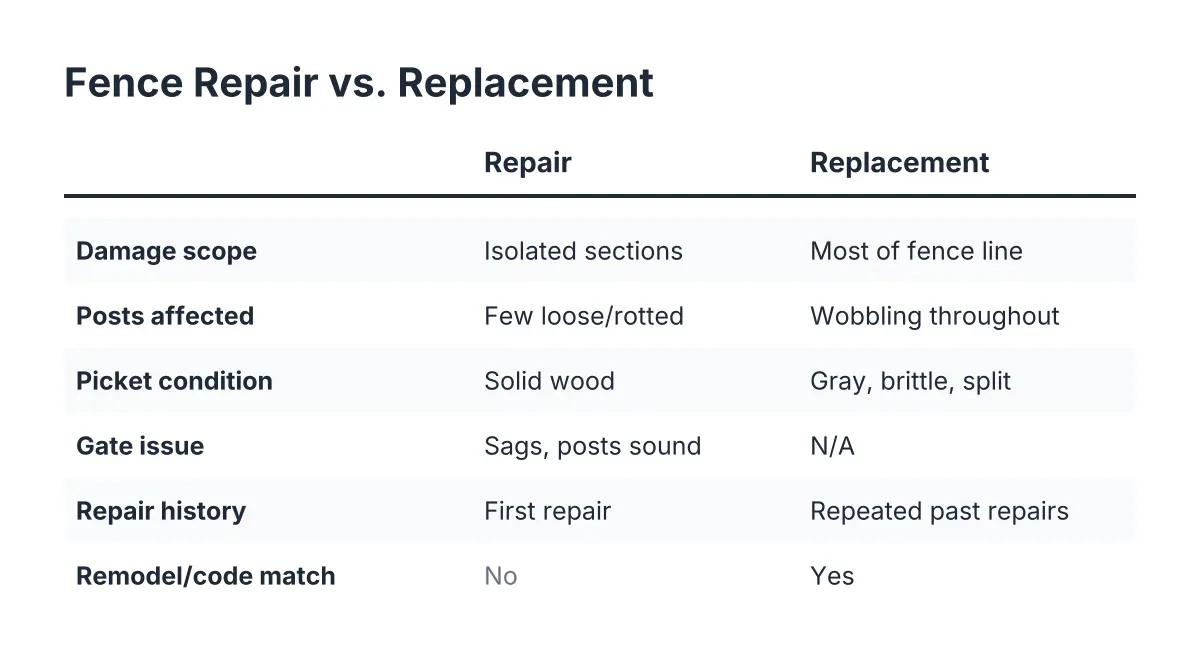
Not every fence problem needs a contractor. A homeowner can reasonably handle re-securing loose pickets, replacing a damaged board or two, tightening gate hardware, and resealing or staining wood. Those are maintenance tasks, and doing them promptly extends the life of any fence.
Call a professional when the problem is structural. Leaning or heaved posts, a gate that no longer closes square, a fence line pulling apart on a slope, or sections failing after storms all point to the posts and the ground, not the boards. Patching pickets on a fence with failing posts is repainting a car with a cracked frame. Likewise, any project tied to a pool permit needs code-compliant fencing from the start; retrofitting compliance costs more than building it in.
Timeline-wise, be wary of anyone promising exact scheduling before seeing the job. Weather, ground conditions, and material availability all move fence schedules, and in 2026 material pricing remains unsettled enough that a fair contractor will tell you how long a quoted price holds rather than pretend it holds forever.
How to Get a Fence Installation Quote That Holds Up
Pulling it together, here is the process that protects you:
- Walk your own yard first. Note the slope, where water runs after rain, where old posts leaned, and where the fence meets concrete, trees, or a neighbor's fence. These observations are your quote checklist.
- Request a site visit, not a phone number. On a problem lot, the visit is the quote. Point out everything you noted and watch whether the contractor engages with it or waves it off.
- Ask the four questions above. Post setting in clay, slope handling, panel layout, and warranty scope. The answers tell you more than the price does.
- Get the scope in writing, itemized. Materials, post method, gates, tear-out, site work, and named contingencies for foreseeable conditions.
- Compare scopes before comparing totals. The cheapest number on a different scope is not the cheapest fence. It is a different fence.
When you get a fence installation quote this way, you are not just pricing a fence. You are auditioning the thinking that will hold your fence up through the next ten wet springs and dry summers.
If you are in Mansfield or nearby and want that kind of quote, walk-the-lot included, Mansfield TX Fence Pros will look at your actual slope, your actual soil conditions, and your actual project, whether that is a cedar privacy fence, vinyl fence installation beside a new pool, a concrete fence on an exposed line, or gate installation that stays square. Reach out to schedule a site visit and get a fence quote built on your yard, not an average.
If you need fence installation in Mansfield, TX, Mansfield TX Fence Pros can help.
Prefer to talk it through? Call (817) 383-9360 — a quick call is usually the fastest way to get a straight answer for your situation.