DIY Gate Installation vs. Professional: 8 Reasons Mansfield Soil Decides It
If you are weighing DIY gate installation on clay soil against professional install on a Mansfield lot, the honest answer starts underground. North Texas clay soil swells when it rains and shrinks when it bakes, and a gate is the one part of your fence that has to swing true through all of it. A fence panel that leans a little still works. A gate that leans a quarter inch stops latching.
This matters even more if your lot slopes, if your last fence posts rotted or heaved within a few years, or if you are planning a long perimeter run with a driveway gate on acreage. Below are eight points that separate a gate that works for a season from one that works for a decade, and where the DIY versus professional decision actually tips.
1. Clay Soil Movement Is the Real Opponent, Not the Hardware
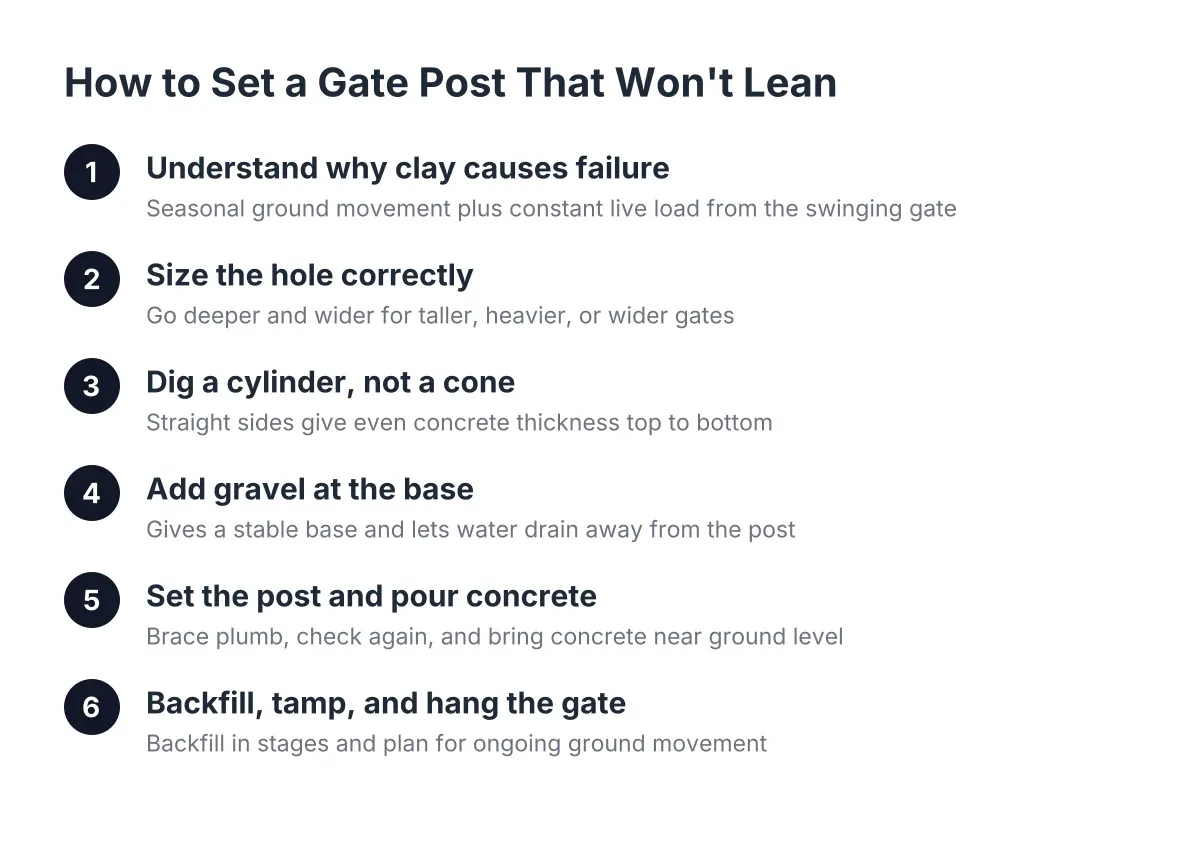
Most DIY gate failures in this area trace back to the ground, not the hinges. Mansfield sits on expansive clay that moves with seasonal moisture swings; a post set in it can heave after a wet spring and settle after a dry August. A gate hung between two posts that move independently will sag, bind, or drag.
A professional installer plans for that movement with deeper footings, proper concrete placement, and hardware choices that leave room for adjustment. When tackling DIY gate installation in clay soil, a weekend installer following a generic how-to video written for stable sandy soil often does not plan with sufficient depth. If your existing fence posts started leaning after a rainy season, you have already seen this problem in action; the gate post is where it shows up first and worst.
2. Gate Posts Are Not Fence Posts, and Slopes Make That Worse
A gate post carries live, swinging weight all day, every day. A fence post holds a static panel. That difference is why gate posts need larger diameter holes, deeper footings, and often steel reinforcement, especially for a 6 ft wood fence gate or anything wider.
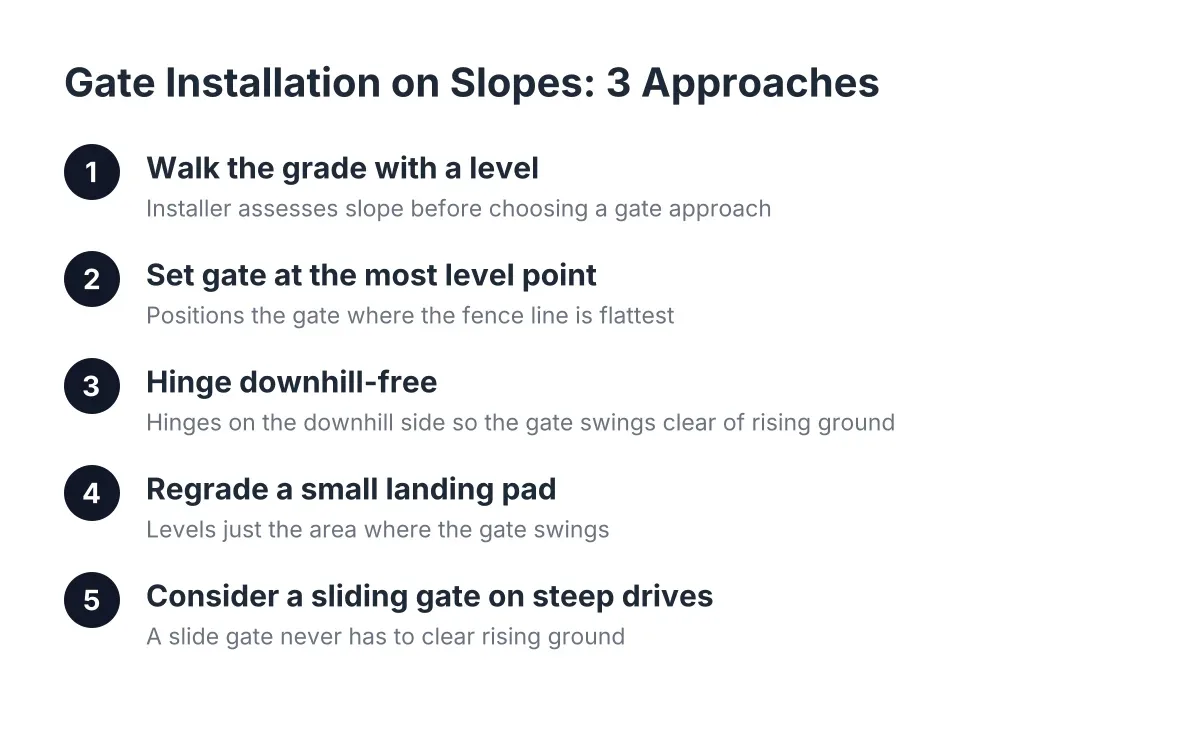
On a sloped yard, the problem compounds. The gate has to clear grade through its full swing, which means the installer must account for the rise or fall of the ground across the opening. Get that wrong and the gate scrapes dirt on one end or leaves a dog-sized gap on the other. For sloped lots, this layout decision is where professional experience earns its fee before a single hole is dug.
What It Takes for DIY Gate Installation Success on a Slope
You can install a fence gate on a slope yourself, but the layout work is unforgiving. You must map the grade across the full swing arc, decide whether to follow the slope or step the fence, and set posts plumb on uneven ground. Most DIY gate problems on slopes come from skipping that planning, not from the carpentry itself.
If the grade change across your opening is more than you can shim with hinge placement, or if drainage runs through the gate path, bring in a professional to assess it. Water moving through clay under a gate post is the fastest route to a leaning post.
3. The Most Common DIY Mistake Happens at Ground Level
A frequent failure point is concrete poured to a couple inches below grade, then topped with dirt or sod to hide it. That backfilled layer traps moisture right where the post meets the ground, and that contact point rots or rusts out years before the rest of the post. The gate then leans even though the footing below is solid.
Proper practice brings the concrete to grade and crowns it so water sheds away from the post. It is a small detail that takes no extra skill, just knowing it matters. Tamping dirt back into the hole with no concrete or foam footing at all is worse; in clay soil that shifts with every moisture swing, that approach is not an acceptable building practice for a gate post.
4. Where DIY Gate Installation Beats Hiring a Professional
A straightforward walk gate in an existing wood fence, on flat ground, with sound posts already in place, is a reasonable weekend project. If the posts are plumb, set in good concrete, and sized for gate duty, you are mostly doing carpentry and hardware work. Plenty of handy homeowners do it well.
DIY also makes sense when the stakes of failure are low. A side-yard gate to the trash cans that sags slightly is an annoyance. A driveway gate that sags is a security gap and a vehicle hazard. Match the installation approach to what the gate protects.
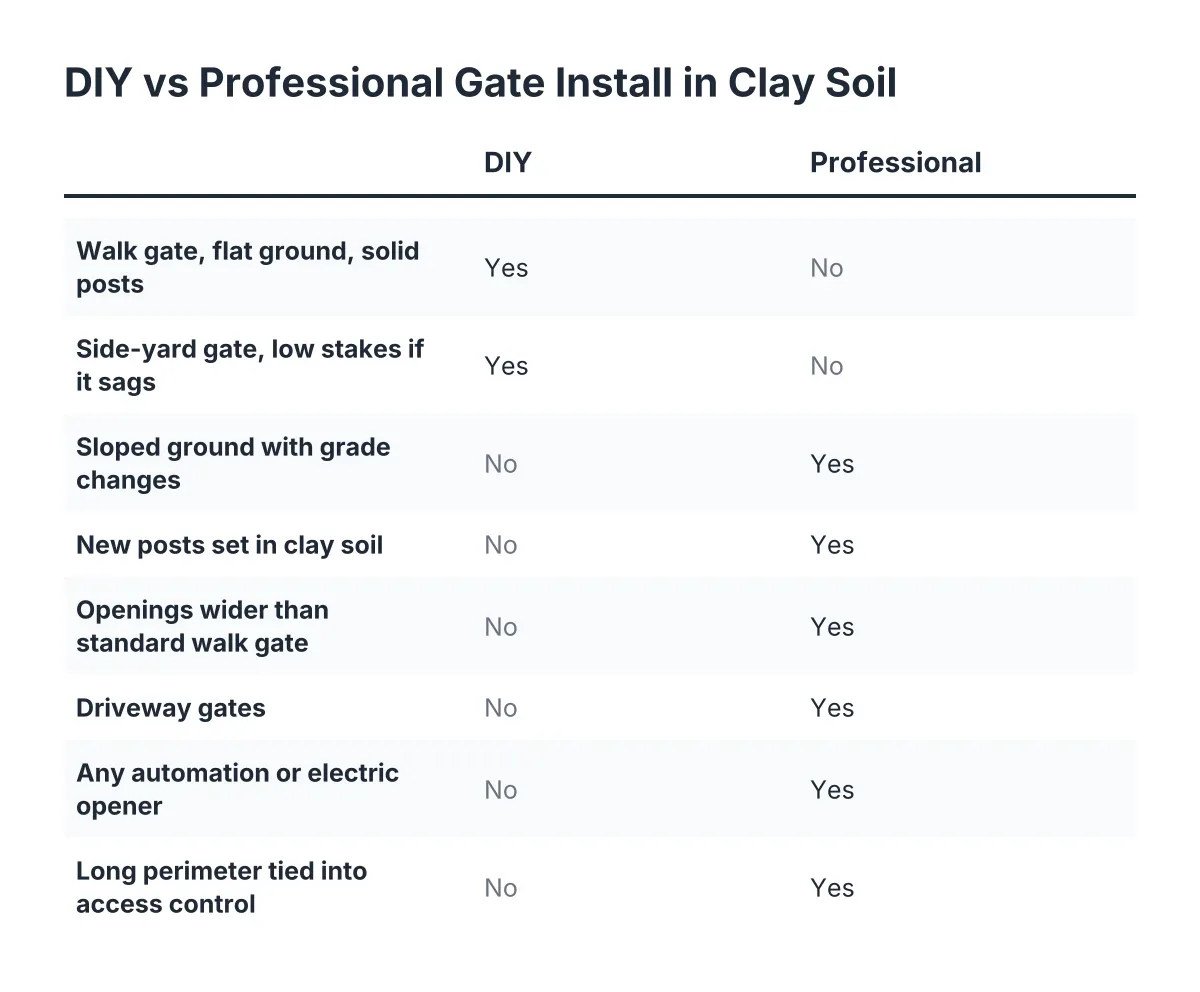
- Good DIY candidates: walk gates on flat ground, existing solid posts, standard widths, manual latches
- Lean professional: sloped ground, new posts in clay, openings wider than a standard walk gate, driveway gates, any automation
- Always professional: electric gate openers with vehicle traffic, long perimeter runs tied into access control
5. Why Driveway Gates and Automation Push the Decision Toward a Professional
A driveway gate on acreage is a different project than a backyard walk gate. The posts carry far more weight, the opening is wider, and the gate often ties into an electric opener, keypads, or signal-based access control. The automatic gate market is large and growing; Research and Markets estimated the global automatic gate opening system market at $2.8 billion in 2025, which means plenty of consumer-grade DIY kits exist. The kits are real, but the site work under them is where they fail.
An automated gate that binds because its posts shifted will burn out its opener motor. Automation also brings safety obligations: entrapment protection, sensing loops or photo eyes, and correct force settings. For a property owner installing a long perimeter fence with an automated entrance in 2026, professional gate installation is less about convenience and more about not paying twice.
6. Material Choice Changes the Difficulty, Not Just the Look
Each gate material carries its own installation traps. A wood or cedar gate needs diagonal bracing or a steel frame to resist sagging as the wood dries in Texas heat. A vinyl gate is only as strong as what holds the screws; reinforcing the uprights with internal inserts makes the frame far more resistant to pulling apart. Additionally, a metal gate outdoor installation resists sag best but demands precise post placement, because steel does not forgive a post that is half an inch off plumb.
Professionals also use tricks that rarely appear in DIY guides. In tight spots, such as butting against a neighbor's fence or working around a tree, a steel pipe post with a vinyl sleeve over it gives strength the standard hollow post cannot. These are the judgment calls that separate a gate that survives Mansfield's heat, ice events, and moisture swings from one that does not.
7. Small Hardware Decisions That Anticipate Ground Movement
Experienced installers set gates up to keep working after the ground moves, because in clay soil it will. Two habits make the difference. First, placing the latch striker near the top of its adjustment range leaves room for the gate to drop slightly as posts settle and still latch cleanly. Second, installing the striker before hanging the gate helps position the gate correctly during hanging, since the striker placement effectively self-aligns it.
Neither trick costs money. Both come from understanding that a gate in North Texas is a moving part mounted on moving ground. If you do go the DIY route, these two details will do more for the gate's working life than any premium hinge.
8. Count the Full Cost Before Calling DIY Cheaper
The DIY math usually compares the hardware kit against a contractor quote and stops there. The honest comparison includes the auger or core drilling rental, concrete, steel reinforcement for the gate post, your time, and the cost of redoing it if the posts move. For context on the broader project, HomeAdvisor puts average fence installation at $23 per linear foot, with a typical range of $6 to $50 depending on material and labor; gates sit at the expensive end of any run because of the post and hardware work.
There is also a long-cost trap worth naming. The cheapest install, whether DIY or a low-bid contractor, often costs more over time because it gets rebuilt years sooner than a quality job. For someone who wants the fence and gate done once, durability per dollar matters more than the lowest number on day one.
DIY Gate Installation and Professional Work on a Real Sloped Lot
Suppose a homeowner on a two-acre Mansfield lot wants a double driveway gate where the drive drops noticeably from the street to the house. A typical professional crew would set a string line across the post tops to keep height consistent above the sloping grade, dig oversized footings for the gate posts, and plan the swing so both leaves clear the rising ground. A DIY install on that same site commonly sets the posts at fence-post depth, hangs the gate level to the bubble instead of the grade, and discovers the bind the first wet month.
In that scenario, the professional cost difference buys the layout judgment, not just the labor. That is the honest trade: on flat ground with good posts, DIY captures most of the value; on slopes and clay, the professional's site reading is the product.
The Bottom Line for Mansfield Lots
Here is the short version of the DIY gate installation versus professional decision for this area. If the ground is flat, the posts exist and are solid, and the gate is a standard manual walk gate, DIY is a fair project with the ground-level details above. If the lot slopes, the posts are new, the opening is wide, or automation is involved, the ground conditions that worry you are exactly the conditions that justify a professional.
One more honest caveat: no installer, professional or otherwise, can stop clay soil from moving. Good installation anticipates the movement and leaves adjustment room; it does not eliminate it. Expect a gate in North Texas to need occasional hinge and latch adjustment regardless of who installs it. The goal is a gate that adjusts in minutes rather than one that fails in seasons, and that outcome is decided the day the posts go in.
If you need gate installation, Mansfield TX Fence Pros can help.
Prefer to talk it through? Call (817) 383-9360 — a quick call is usually the fastest way to get a straight answer for your situation.