Residential Driveway Gate Options in Mansfield, TX: 8 Styles Compared
If your fence posts have leaned after a rainy season, or you manage a community where the perimeter gate keeps sagging, you already know the real question is not "which gate looks best." It is "which gate survives this ground." This guide walks through driveway gate styles compared for Mansfield, TX, covering wood, cedar, vinyl, metal, and concrete options, plus the foundation and automation choices that decide whether a gate still swings true in five years. Each option below is self-contained: what it is, where it fits, and what drives the price up or down on North Texas clay.
One quick note on cost before the list. Gate pricing in 2026 is driven by a handful of factors: material, width of the opening, whether the gate swings or slides, automation, and site conditions like slope and soil. For context on fencing generally, the average cost to install a fence is $23 per linear foot, with a typical range of $6 to $50 per linear foot depending on material and labor, according to HomeAdvisor. A driveway gate sits on top of that math as its own line item, and site prep is usually the variable that moves the number most.
1. Cedar and Wood Driveway Gates: Warm Looks, Heavy Frames
A wood or cedar driveway gate matches a cedar privacy fence better than anything else, which is why it stays popular in Mansfield neighborhoods with wood perimeter fencing. The catch is weight. Wood is heavy, it absorbs moisture, and a wide wood gate will sag over time unless it hangs from a steel frame with serious hinge posts. In practice, most durable wood driveway gates are a steel frame skinned with cedar pickets, so you get the wood look without asking wood to carry its own weight.
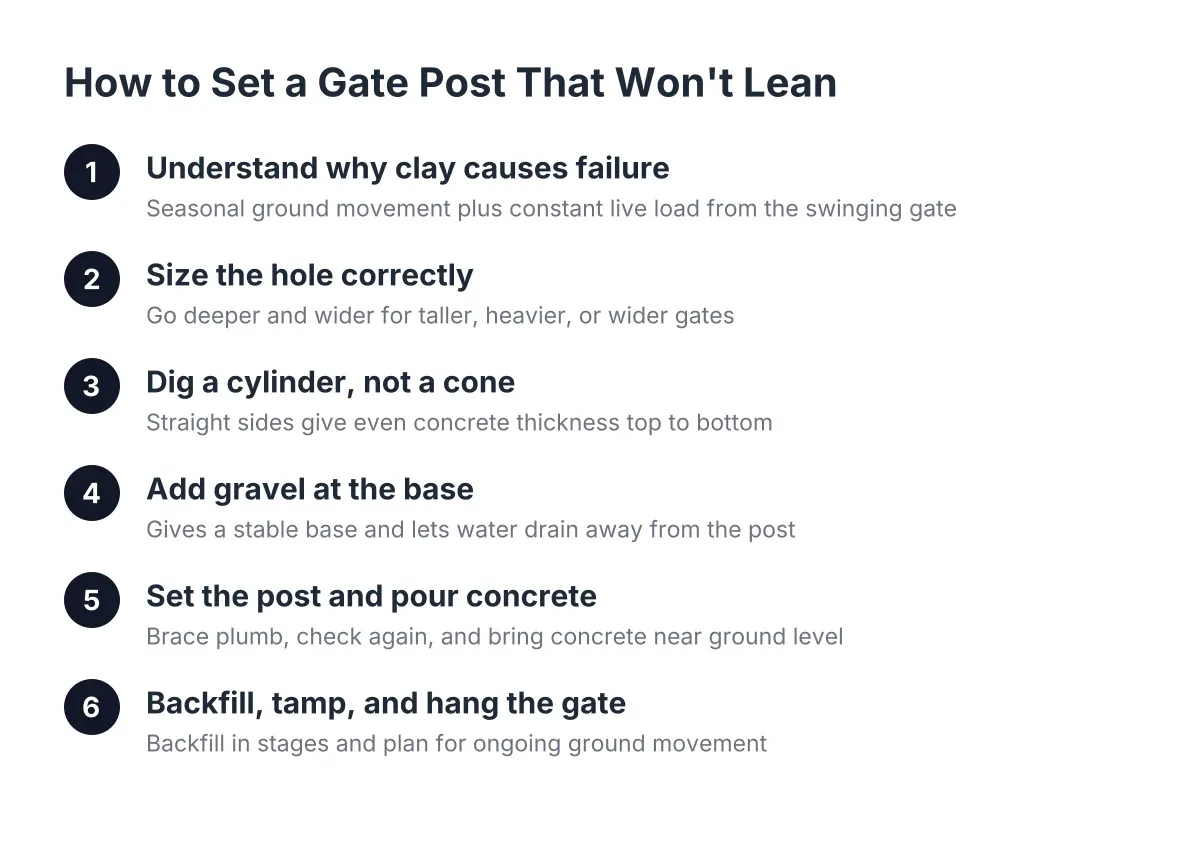
For the homeowner worried about posts leaning, this is the option where foundation work matters most. Clay soil swells when wet and shrinks when dry, and a heavy gate multiplies that stress on the hinge post. When comparing driveway gate styles and the structural load each creates, cedar gates demand deeper, wider concrete footings on the hinge side than a standard fence post gets. Cedar also needs periodic sealing to handle Mansfield's hot summers and occasional ice events, so budget for maintenance, not just installation.
2. Vinyl Driveway Gates: Low Maintenance, With One Structural Caveat
Vinyl driveway gates pair naturally with vinyl fence runs and never need staining, which appeals to HOA boards tired of approving repaint cycles. Vinyl handles sun and rain well, and it will not rot the way an unsealed wood gate can. However, hollow vinyl uprights are the weak point. Screws and hinge hardware can pull out of unreinforced vinyl under repeated swinging loads.
The fix is internal reinforcement. A quality installer adds a channel insert inside the hinge-side upright so the hinge screws bite into something solid; the latch side rarely needs the same treatment because latch hardware carries far less load. Ask any vinyl gate bidder how they reinforce the hinge side. If the answer is a blank look, keep bidding. For HOA communities with shared vinyl fencing, this one detail separates gates that last from gates that end up on the repair list every spring.
3. Steel and Wrought Iron Style Gates: The Workhorse for Wide Openings
Steel is the default material for wide driveway openings because it spans distance without sagging. A steel gate can be fabricated as a classic wrought iron style with pickets and scrollwork, or as a clean modern frame with horizontal infill. Powder coating is the finish that matters in North Texas; it protects against summer heat and the freeze-thaw swings that chip cheaper paint.
Steel also takes automation hardware better than wood or vinyl. Operator arms, slide tracks, and access keypads all mount cleanly to a steel frame. The trade-off is rust at welds and ground contact points if the coating is scratched and ignored, so plan on inspecting the finish every year or two. For a community entrance gate that cycles dozens of times a day, steel is usually where the conversation starts.
4. Aluminum Gates: Lighter Weight, Easier on Shifting Soil
Aluminum gives you the metal look at a fraction of steel's weight, and it will not rust. That lighter weight matters more in Mansfield than in places with stable ground. A lighter gate puts less leverage on the hinge post, which means clay movement during a wet spring does less damage to alignment. For a single-family driveway on a lot with known soil movement, aluminum is often the forgiving choice, especially when driveway gate styles compared show material weight as a key variable in post durability.
The limitation is strength. Aluminum dents and bends more easily than steel, so it is a weaker fit for high-traffic community entrances or anywhere vehicle strikes are a realistic risk. For a quiet residential driveway, that risk is low and the soil benefit is real.
5. Concrete and Precast Gate Surrounds: Built for Perimeter Walls
Concrete does not make the gate leaf itself; it makes the structure around it. Precast concrete fence panels and columns create the gate opening, and a steel or aluminum gate hangs between concrete pillars. This is the standard setup for HOA perimeter walls, and it is the configuration most property managers in Mansfield are bidding when a community entrance ages out or fails inspection.
The skeptic's question here is fair: does Mansfield clay crack concrete? It can, when footings are shallow or drainage is ignored. Concrete columns supporting a gate need engineered footings sized for the soil, and the grading around them needs to move water away, not pool it against the base. When a neighbor's concrete fence shows cracking, the cause is usually water and footing depth, not the concrete itself. A contractor who talks about drainage before talking about panels is reading the site correctly.
6. Swing vs. Sliding: How Different Driveway Gate Styles Compared on Slope
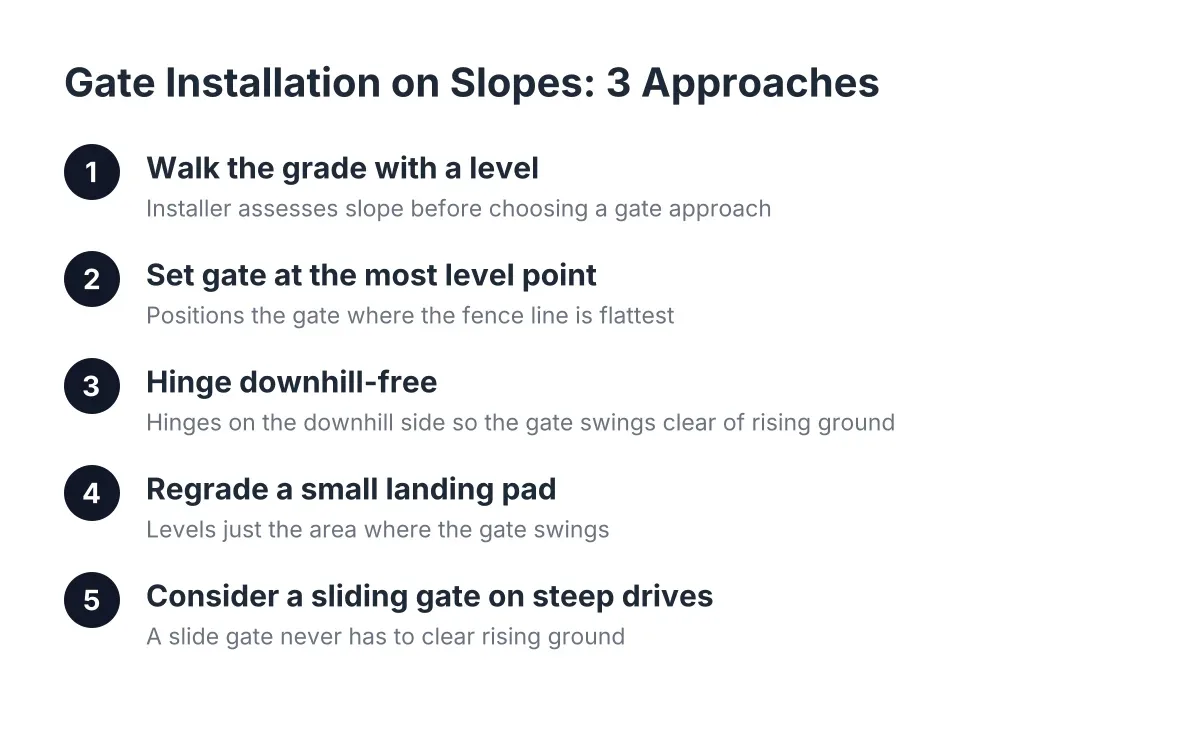
Swing gates are simpler and cheaper to install, but they need flat, clear space to open through. Sliding gates need a run of level ground beside the opening, plus a track or cantilever system, but they work on driveways that slope up from the street. On a sloped Mansfield lot, this decision often makes itself.
Suppose a homeowner near Walnut Creek has a driveway that rises toward the house. A swing gate opening inward would drag on the pavement within a few feet. In that scenario, the realistic choices are a sliding gate, an outward swing if setbacks allow it, or regrading, which costs more than the gate. Installers handle slope on fence runs by setting a string line across post tops to keep height consistent above grade; a gate opening gets the same treatment, because the gate bottom has to clear the pavement through its entire travel.
7. Automatic Gates and Openers: Convenience With Honest Downsides
Automation turns any of these residential driveway gate options into a push-button entrance, and demand keeps growing; the global automatic gate opening system market was estimated at $2.8 billion in 2025, according to Research and Markets. For a single driveway, a mighty mule gate opener or a comparable LiftMaster unit handles most swing gate setups. Community entrances usually need commercial-grade operators rated for constant cycling, plus keypads, remotes, or signal access for residents.
Be honest about the downsides before you commit:
- Power dependence. The gate needs electrical supply or a solar setup, and a battery backup for outages.
- Maintenance. Operators, sensors, and safety loops need periodic service, especially on high-cycle community gates.
- Cost stacking. The opener, electrical run, safety sensors, and access controls each add to the base gate price.
- Foundation sensitivity. An automated gate tolerates less post movement than a manual one; a hinge post that heaves half an inch can throw the operator out of alignment.
That last point is the one Mansfield's clay makes personal. Automation raises the stakes on getting the footings right the first time.
8. The Foundation Under Every Option: Posts, Footings, and Core Drilling
Whatever material you pick, the gate is only as good as what holds it up. Gate posts carry a swinging or sliding load that ordinary fence posts never see, so they get larger concrete footings set deeper into the ground. On lots where moisture swings are severe, some installers reinforce the post itself, sleeving the visible post over a steel pipe set in concrete so the structure does not depend on the outer material alone.
Core drilling enters the picture when a post has to land on existing concrete, like a driveway apron or a masonry column pad, and the surface needs to stay intact. Instead of breaking out the slab with a jackhammer, the crew drills a clean round hole through it and sets the post inside. If your gate posts sit on or beside existing flatwork, ask bidders whether they core drill or demo and patch; the answers affect both price and how the finished job looks.
One honest limitation: no article can tell you what your specific soil needs. A yard with active movement, a steep cross-slope, or an existing retaining issue warrants an on-site assessment before anyone quotes footing depth, and sometimes a drainage fix comes before the gate does.
How to Narrow Residential Driveway Gate Options for Your Property
Here is a short decision path that covers most Mansfield situations:
- Match the fence first. A cedar privacy fence usually wants a cedar-skinned gate; a precast concrete perimeter wants metal between concrete columns.
- Let slope pick swing or slide. Flat, clear swing path means a swing gate; a rising driveway points to sliding.
- Weigh soil movement against weight. Known clay movement favors lighter aluminum or a reinforced, deeper-footed install for steel and wood.
- Decide on automation early. The opener affects post specs, electrical runs, and layout, so it belongs in the initial design, not a retrofit.
- For HOA projects, spec the duty cycle. Resident traffic volume determines whether a residential opener or a commercial operator is the right bid.
What a Gate Installation Quote Should Spell Out
A trustworthy quote for gate installation names the material, the opening width, the post and footing specs, the hardware, any core drilling or grading, and the automation package if included. Vague line items like "site prep" with no description are where surprise costs hide. For HOA boards gathering competitive bids, requiring that level of detail from every bidder is the simplest way to compare proposals on substance instead of price alone.
The pattern across all eight options is the same. Material choice sets the look and the maintenance load. The ground sets everything else. In Mansfield, TX, the installers worth hiring talk about footings, drainage, and slope before they talk about styles, because that order is how a driveway gate ends up still hanging straight when the clay does what clay does.
If you need fence installation in Mansfield, TX, Mansfield TX Fence Pros can help.
Prefer to talk it through? Call (817) 383-9360 — a quick call is usually the fastest way to get a straight answer for your situation.