Fence Company Financing in Mansfield, TX: Payment Plans and Approval Steps
A broken gate or a leaning fence rarely waits for a convenient budget cycle. Whether you are a homeowner with a driveway gate stuck open or a property manager staring at storm-damaged perimeter panels, the money question comes fast. That is why fence company financing in Mansfield comes up in so many first phone calls. Understanding the fence financing approval process helps you compare bids and prepare for each step. This guide walks through how payment plans typically work, what the approval process looks like, and the questions worth asking before you sign anything, laid out as a practical checklist you can use while you compare bids.
One note up front: fence financing is not one product. It ranges from third-party consumer loans arranged through the contractor, to progress payments on larger projects, to HOA capital budgets spread across phases. Knowing which type fits your situation saves time and keeps you from comparing apples to oranges.
1. Know the Main Ways a Fence Company Offers Financing
Most fence contractors offer one or more of three payment structures. First, third-party financing: the contractor partners with a lender, you apply, and if approved you pay the lender monthly while the contractor gets paid at completion. Second, staged or progress payments: a deposit at signing, a payment at material delivery or project midpoint, and the balance when the work passes your walkthrough. Third, for commercial and HOA work, phased contracts that split a large perimeter project across budget years.
Each structure suits a different buyer. A homeowner replacing a cedar privacy fence after a windstorm often leans on third-party financing. An HOA board replacing aging concrete fence panels usually prefers phased contracts that match its reserve schedule and bid process.
2. Understanding the Fence Financing Approval Process in Mansfield
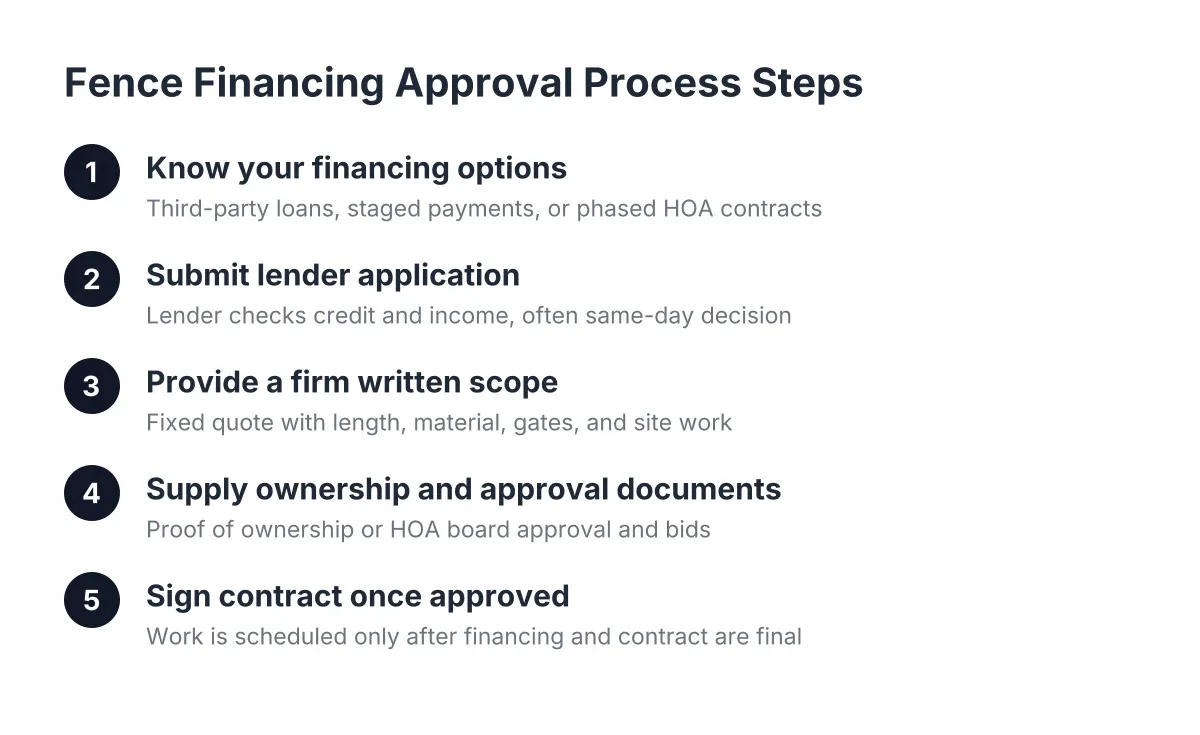
Approval for fence company financing in Mansfield usually runs through the lender, not the contractor. You fill out a short application, the lender checks credit and income, and you get a decision, often the same day. The contractor's role is to provide a firm written scope and price the lender can fund against. The fence financing approval process depends on clear documentation from the start.
Therefore, the quote matters as much as the application. Lenders fund a specific contract amount, so a vague estimate full of allowances creates problems later. Before you apply, get the scope nailed down: fence length, material, gate count, demolition and haul-off, and any site work. Change orders after approval may require a new loan amount or out-of-pocket payment.
What Lenders and Contractors Typically Ask For
Expect the fence financing approval process to involve a few predictable items:
- A written, itemized quote with a fixed total, not a verbal ballpark
- Basic identity, income, and credit information for the loan application
- Proof you own the property or have authority to approve the work
- For HOAs, board approval documentation and sometimes competitive bids
- A signed contract once financing is approved, before work is scheduled
None of this should feel mysterious. A contractor who offers financing regularly can walk you through each step in one conversation.
3. Match the Payment Plan to the Project, Not the Other Way Around
A small fence repair and a full perimeter replacement call for different money strategies. Suppose a Mansfield homeowner wakes up to find a driveway gate stuck open after a storm knocked a post out of plumb. In that scenario, a targeted gate repair or post reset may cost little enough that financing is unnecessary; a staged payment or single invoice makes more sense. Financing earns its keep on bigger scopes: a full cedar privacy fence, a vinyl fence around a large lot, or a concrete fence line for a community.
As a general reference point, HomeAdvisor reports the average cost to install a fence at $23 per linear foot, with a typical range of $6 to $50 per linear foot depending on material and labor. Multiply that range across a few hundred feet of fence line and you can see why payment plans exist. For HOA-scale projects, phasing by fence section often beats a single large loan.
4. Ask What Drives the Price Before You Ask About Payments
Financing spreads a number out; it does not shrink it. The number itself comes from material choice, total fence length, gate count and type, demolition of the old fence, and site conditions. In Mansfield, site conditions matter more than many buyers expect. North Texas clay soils shift with seasonal moisture swings, which stresses fence posts and gate hinges over time, so proper post setting is not a place to cut corners.
Style choices also move the price honestly. Board-on-board and other custom styles take more picket material and more labor than a standard flat privacy fence, so they cost more for real reasons, not markup games. In addition, a quote that only tamps dirt around posts with no concrete footing is a red flag, not a bargain; that practice is widely considered unacceptable in the trade. When you compare a fence company near me on prices, make sure every bid describes the same construction method.
5. Watch for the Cheap Bid That Costs More Than the Loan
Here is the trade-off nobody puts in their ad: the cheapest contractor often produces the most expensive fence. A bargain build that sags in three summers of clay-soil movement has to be rebuilt long before a quality installation would, and the second project usually costs more than the difference you saved up front. Financing changes this math in a useful way. If a payment plan lets you afford the better-built fence now, you may spend less over the fence's life than paying cash for the cheap one.
However, financing has its own trade-off. You pay interest or fees for the convenience, so a loan on a marginal project can erase the savings of a better build. Run both numbers: total cost of the quality fence financed, versus total cost of the cheap fence paid in cash plus a likely earlier replacement. For most long-term owners and HOAs, the first number wins, but it is worth doing the arithmetic rather than assuming.
6. Factor in Permits and Local Rules Before Money Changes Hands
Permitting affects both timeline and budget, and it is easy to overlook when you are scrambling after storm damage. Mansfield offers some relief for smaller jobs: according to City of Mansfield, Texas, replacing or repairing an existing wood privacy fence is exempt from permitting when the work covers less than 50% of the total linear footage of fencing on the property. Larger replacements, new fence lines, and height or material changes may trigger permits and HOA architectural review.
For property managers, the review step is often the slow part. Board votes, bid requirements, and architectural committee approvals can take longer than the installation itself. Line up financing or budget approval in parallel with those reviews so the project does not stall twice.
7. Know When Financing a Repair Beats Financing a Replacement
Not every failing fence or gate needs full replacement, and a trustworthy contractor will say so. For example, interim wood post repairs that preserve the existing concrete footings can keep a sagging fence upright now, and that repair spend effectively carries forward toward a future full rebuild with steel posts. For gates, a motor or hardware issue is often serviceable without touching the fence line at all; the global market for automatic gate opening systems was estimated at $2.8 billion in 2025, according to Research and Markets, which reflects how common powered gates and their service needs have become.
If you are worried a repair visit will turn into a replacement pitch, ask the estimator to price both paths in writing. A repair quote next to a replacement quote, each with its own payment option, lets you decide on facts instead of pressure. When the frame is rotted, the posts have heaved out of the clay, or the gate operator is obsolete, replacement is the honest answer; a written comparison makes that conclusion easy to verify.
8. Questions to Ask Any Fence Company About Financing in Mansfield
Before you commit, put three questions to every bidder. These separate contractors with a real fence financing approval process from those improvising one.
- Who actually carries the loan, and what are the terms? If a third-party lender is involved, get the rate, term, and any promotional-period fine print in writing.
- What is the payment schedule tied to? Payments should track milestones you can see: signed contract, material delivery, completed installation, and a final walkthrough.
- What happens if the scope changes mid-project? Hidden sprinkler lines, buried debris, or an HOA revision can change the price; ask how change orders affect your financing.
A fair quote supports these answers with an itemized scope: material and style, linear footage, gate installation details, post setting method, demolition, and haul-off. If you searched fence company with financing near me and the bidder cannot answer these three questions plainly, keep looking.
9. For HOAs and Property Managers: Treat Financing as Phasing
If you manage 50 or more units with a shared perimeter concrete fence or community signal gate, consumer-style loans usually are not the right tool. Instead, the useful version of financing is contract phasing: splitting the perimeter into sections, bidding the whole scope once, and scheduling payments across one or more budget years. This keeps board approvals clean, locks pricing for later phases where possible, and lets you fix the worst sections first.
Say a community's precast concrete fence fails inspection along one street while the rest has a few years of life left. A phased contract repairs the failed run this fiscal year and schedules the remaining sections against the reserve study, with each phase billed as it completes. Ask bidders whether they can handle concrete fence work at that scale and whether their proposal maps to your budget cycle; many residential-only crews cannot.
10. Put It Together: A Simple Decision Path
Pull the previous nine items into one sequence and the decision gets manageable. First, define the scope in writing: repair versus replacement, material, footage, and gates. Next, get itemized bids that describe construction method, not just totals; the best residential fence company near me is the one whose quote you can actually compare line by line. Then, match the payment structure to the project size, from a single invoice on a gate repair up to third-party financing or phased contracts on full installations. Finally, confirm permits or HOA approvals before signing, so the funded contract matches the work that is allowed.
Financing questions are also a useful character test. A fence company that explains its payment plans, approval steps, and cost drivers in plain language before you ask twice will usually run the installation the same way. One caution applies throughout: loan terms, credit decisions, and HOA governance rules vary by situation, so for large projects or complex boards, have your lender, attorney, or management firm review the contract before funds move.
If you are weighing a wood fence, cedar privacy fence, vinyl fence, concrete fence, or a new driveway gate anywhere in Mansfield, Mansfield TX Fence Pros will walk you through the cost drivers, the payment options, and the approval steps with straight answers. Reach out for an estimate on your installation, fence repair, or gate installation, and bring your questions about financing in Mansfield; clear answers up front are the whole point.
If you need fence installation in Mansfield, TX, Mansfield TX Fence Pros can help.
Prefer to talk it through? Call (817) 383-9360 — a quick call is usually the fastest way to get a straight answer for your situation.