Metal Fence Gate Installation in North Texas: Materials That Survive the Heat
If your gate just failed, you are probably not thinking about metallurgy. You are thinking about the dog that can now wander out, or the driveway gate stuck half open while you are trying to leave for work. But here is the thing most Mansfield homeowners learn the hard way: the gate that just broke probably failed for a reason that was baked in on the day it was installed. A metal fence gate that is built and hung for North Texas conditions, the clay soil, the heat, the moisture swings, lasts for years without drama. One that is not becomes the gate you are fighting with right now.
This guide walks through why gates fail here, what a metal fence gate is actually made of, which metals hold up in our climate, and how to tell whether your broken gate needs a repair or a rebuild. By the end, you should be able to look at your own gate and understand what you are dealing with before you call anyone.
Why Gates Fail First in Mansfield Yards
Walk down any street in Mansfield and you will see it. The fence is standing fine, maybe a little gray, but the gate sags. The latch does not line up anymore. Someone has tied it shut with a bungee cord or wedged a brick under the corner.
Gates fail before fences do because a gate is the only part of the fence that moves. A fence panel just has to stand there. A gate has to swing hundreds of times a year, hold its shape while hanging from one side, and still meet its latch within a fraction of an inch. Every weakness in the materials or the installation shows up at the gate first.
North Texas makes this worse in three specific ways:
- Clay soil that moves. Our soil swells when it rains and shrinks hard during summer drought. Gate posts ride that movement up, down, and sideways. A post that shifts even slightly throws the whole gate out of alignment, and the latch stops catching.
- Heat that punishes wood. Hot summers dry out wood gate frames, and the boards cup, twist, and pull away from their screws. A wood gate that was square in April can drag the ground by August.
- Moisture swings and storms. Heavy seasonal rain soaks the ground around posts, then wind loads the gate like a sail. Storm damage is one of the most common reasons homeowners search for gate repair near me in the first place.
So when your gate sticks open or will not latch, the gate itself is often only half the story. The posts, the hinges, and the soil under them are the rest.
What a Metal Fence Gate Actually Is
A metal fence gate is a gate built on a welded or bolted metal frame, usually steel or aluminum, that holds its shape independently of whatever covers it. The frame can carry metal pickets for an ornamental look, or it can carry cedar boards so the gate matches a wood privacy fence. The metal is the skeleton; the facing is the skin.
This matters because the most common gate failure in Mansfield is not a broken hinge or a bad latch. It is a wood gate frame that has racked out of square. Wood joints loosen as the boards expand and contract, the gate drops at the latch corner, and from then on you lift the gate to close it. A welded metal fence gate frame does not rack. The corners are fixed. If the posts stay put, the gate stays square.
The parts worth knowing by name:
- The frame. The structural rectangle, often with a diagonal brace. On a metal gate kit this is usually welded steel tube or aluminum.
- The posts. The hinge post carries the entire weight of the gate, all day, every day. The latch post only has to hold a striker. The hinge post is where installation quality shows.
- The hinges. Gate hinges rated for the gate's weight, not generic door hinges. Undersized hinges are a slow-motion failure.
- The latch and lock. A gate latch that self-aligns forgives small seasonal post movement. A rigid latch does not.
- The facing. Metal pickets, cedar boards, or vinyl, depending on the fence it joins.
When homeowners shop metal fence gates online, they mostly see the facing. Installers look at the frame, the posts, and the hinges, because that is where gates live or die.
Which Gate Metals Hold Up in North Texas Heat and Humidity
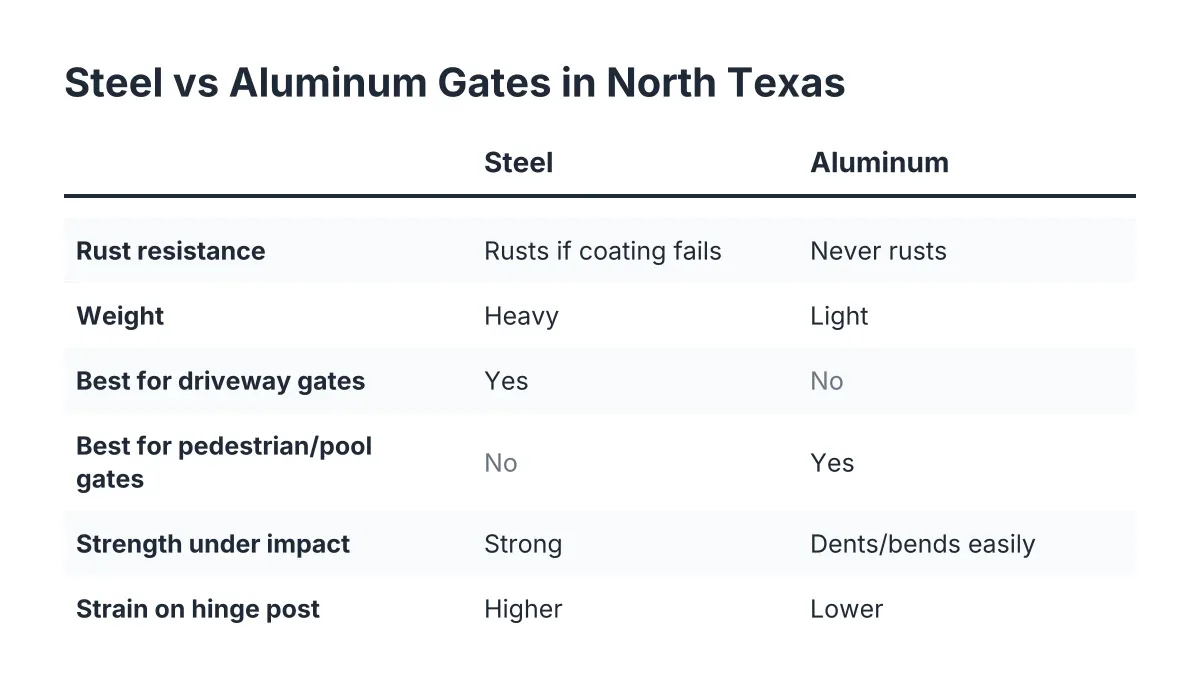
Steel and aluminum both handle North Texas conditions well, but they fail differently and suit different jobs. Steel is stronger and heavier, which suits driveway gates and large openings, but it rusts where coatings fail. Aluminum never rusts and stays light, which suits pedestrian gates and pool fencing, but it bends under impact that steel would shrug off.
Steel: strength first, coating always
Steel is the workhorse for a heavy driveway gate or any wide opening. It resists wind load, it does not flex, and it carries automation hardware without complaint. The catch in our climate is corrosion. Summer humidity, sprinkler overspray, and the occasional ice event all attack bare steel.
Therefore the coating is the whole game. Powder-coated or galvanized steel holds up for years here. Bare or cheaply painted steel starts rusting at the welds and the bottom rail, the places water sits. If you are looking at an older steel gate right now, check the bottom corners and the hinge welds. Surface rust is cosmetic and fixable. Rust that flakes or has eaten through the tube wall is structural, and that gate is on borrowed time.
Aluminum: rustproof and light
Aluminum does not rust, period. That makes it the low-maintenance choice for pedestrian gates, pool enclosures, and ornamental fence lines. Its light weight also means less strain on the hinge post, which matters in clay soil where posts already have a hard life.
The trade-off is strength. Aluminum dents and bends more easily than steel, so it is a weaker choice for a wide driveway gate in a windy, open lot. For a standard walk gate on a suburban Mansfield lot, aluminum is often the longest-lived option with the least upkeep.
Wrought iron and ornamental steel
Traditional wrought iron and modern ornamental steel look sharp and last generations when maintained. However, they demand maintenance: inspection, touch-up paint, and rust treatment on a regular cycle. In our humidity, skipping that cycle for a few years turns a beautiful iron fence gate into a scaling, pitted one. Buy it if you love the look and will keep up with it, or choose powder-coated aluminum that imitates the style without the upkeep.
Steel-framed wood: the privacy fence answer
For most Mansfield homeowners with a cedar privacy fence, the best gate is a hybrid: a welded steel frame faced with the same cedar boards as the fence. You get the look of the wood fence and the geometry of metal. The cedar boards can still weather and get replaced over time, but the frame underneath never sags. If you have replaced a sagging wood gate twice already, this is the upgrade that breaks the cycle.
Why Metal Fence Gate Posts Matter More Than the Gate
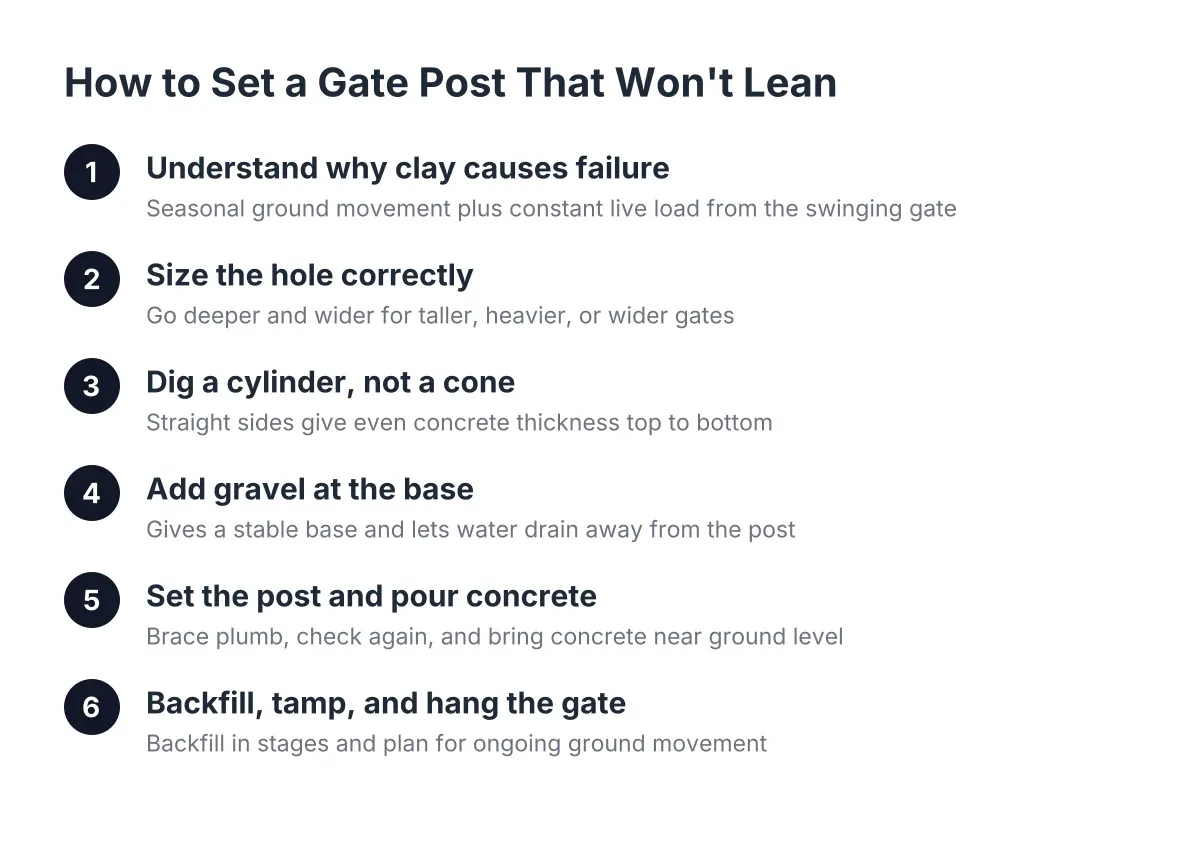
The post holding your gate matters more than the gate hanging from it. In North Texas clay, a hinge post set too shallow or with too little concrete will lean within a few seasons, and even a perfect gate will stop latching. Most "broken gate" calls in Mansfield trace back to a moving post, not a failed gate.
Clay soil shifts with moisture. During a wet spring it swells and can heave a shallow footing upward. During an August drought it shrinks and pulls away, letting the post rock. A gate post needs a deeper, wider concrete footing than a standard fence post because it carries a cantilevered load, the full weight of the gate hanging off one edge, through every one of those cycles.
This is also where material pairings matter. On vinyl fences, for example, the hinge-side post is the one that needs internal reinforcement, often a steel insert the vinyl sleeves over, because the hinge side is where hardware tears out under load. The latch side rarely fails the same way. The general rule holds across materials: reinforce the side that carries weight.
Experienced installers also sequence the work to fight misalignment. Setting the latch striker before hanging the gate, for instance, lets the striker position guide the gate into correct alignment rather than hoping the two meet afterward. Details like that are invisible in the finished product and decisive five years later.
Repair or Replace: Reading Your Broken Gate
You can usually tell whether a gate needs repair or replacement by separating three questions: are the posts solid, is the frame square, and is the hardware intact. If the posts are plumb and the frame is straight, most problems, including sag, latch misalignment, and worn hinges, are repairable. If the hinge post moves or a steel frame has rusted through, repair money is better spent on replacement.
Run this check before you call anyone:
- Grab the hinge post and push. Any visible movement at the base means the post or footing is the problem. No gate adjustment fixes a moving post.
- Sight down the gate frame. A wood frame out of square can sometimes be braced; repeated racking means the joints are done. A bent aluminum frame is usually a replacement. A square steel frame with a latch problem is an easy fix.
- Check steel for rust depth. Surface rust: wire-brush, treat, and repaint. Flaking rust or holes at the bottom rail: structural failure.
- Test the hinges. Loose lag screws in wood can often be refastened or upsized. Hinges tearing out of a vinyl post without internal reinforcement need more than new screws.
- If it is an electric gate, isolate the problem. Open the manual release and swing the gate by hand. If it moves freely, the issue is the opener or its electronics, which is electric gate repair territory. If it binds by hand, fix the mechanical problem first; a new motor cannot push a dragging gate.
That last point trips up a lot of homeowners. Suppose a Mansfield homeowner wakes up to a driveway gate stuck open after a storm, calls a general handyman, and hears "we don't touch gate motors." Half the time the motor is fine. The storm shifted a post or knocked the gate out of alignment, the opener sensed the resistance, and it shut down to protect itself. In that scenario, the fix is mechanical, and the right call is a fence and gate company, not an electrician.
One honest caveat: hidden post rot, buried footing problems, and opener electronics are hard to diagnose from the surface. If the checks above leave you unsure, have a professional open it up before you spend money on parts.
What Professional Metal Gate Installation Includes
A professional gate installation on a residential lot generally covers assessment of the opening and posts, setting or reinforcing posts in concrete sized for a cantilevered load, hanging and squaring the gate, fitting the latch and hinges, and adjusting everything for smooth swing and clean latching. Automation, electrical runs, demolition of old concrete, and custom fabrication are usually priced separately.
Here is the typical scope for a manual metal fence gate on an existing fence line:
- Evaluate the existing posts and fence connection points.
- Set a new hinge post, or reinforce the existing one, with a properly sized concrete footing.
- Fit the gate frame to the actual opening, since real openings are rarely the catalog dimension.
- Hang the gate on weight-rated hinges and set the latch for reliable engagement.
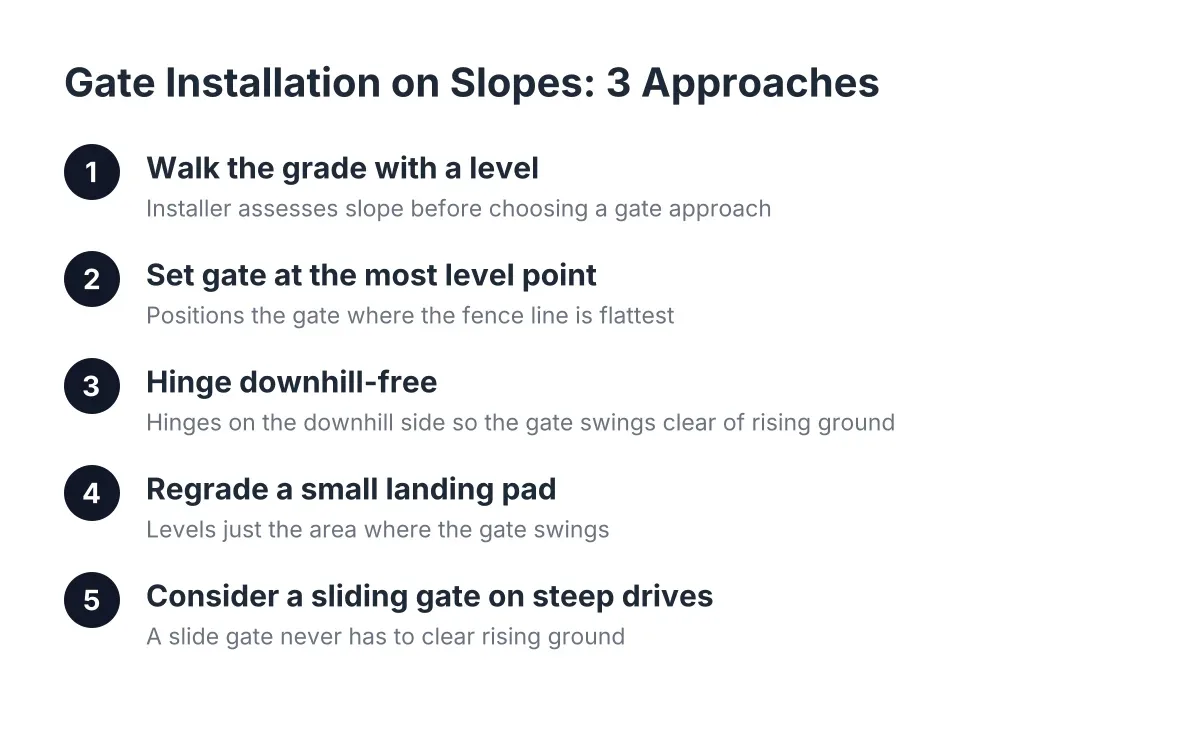
- Adjust for ground clearance, including slope, so the gate swings without dragging.
Timeline depends on concrete. A gate hung on existing solid posts can be a same-day job. New posts need their concrete to cure before carrying weight, which typically stretches the work across more than one visit. Automated driveway gates add opener mounting, safety devices, and power, which extends the schedule further. Exact cost depends on gate size, metal choice, whether posts must be replaced, and site access; a straightforward walk gate sits at the low end, and a custom automated steel driveway gate sits at the top. For broad context, HomeAdvisor puts average fence installation at $23 per linear foot with a wide range by material and labor, and gates price separately from the fence run because of the post and hardware work involved.
On permits, requirements vary by scope and city. As a reference point, the City of Mansfield exempts repair or replacement of an existing wood privacy fence from permitting when the work covers less than half of the property's total linear footage. New gate locations, driveway gates, and automated systems can trigger different rules, so confirm with the city or let your fence company handle it as of 2026.
DIY or hire it out?
A homeowner comfortable with tools can handle hinge tightening, latch adjustment, lubrication, and replacing boards on a steel-framed wood gate. Hiring out makes sense when the job involves setting posts in clay, demolishing old footings, fabricating or modifying a steel frame, matching a gate into an existing fence line, or anything touching an opener's electronics and safety sensors. The post work is the honest dividing line: digging and pouring a footing that survives our soil cycles is where most DIY gates eventually fail.
Choosing a Gate Installer in Mansfield
Searching gate installation near me returns a long list, so filter it with three questions. First, how will you set the hinge post for clay soil, and how deep? A pro should talk about footing size, cure time, and soil movement without being prompted. Second, what frame material do you recommend for my opening and why? You want reasoning about weight, width, and wind, not a one-size answer. Third, if this is a repair call, will you tell me when repair beats replacement? A fair contractor will fix a square frame on solid posts rather than push a full rebuild.
A fair quote is itemized. It should separate posts and concrete, the gate itself, hardware, any demolition, and automation if applicable. A single lump number with no breakdown makes it impossible to compare the two or three bids most homeowners gather, and it hides where the money actually goes.
Be fair to higher bids, too. Gate pricing reflects construction choices and expected lifespan, not just raw material cost. A quote that includes a welded steel frame, a reinforced hinge post, and weight-rated hardware will cost more than a wood-framed gate on the existing posts, and it will also still latch cleanly years from now.
The Takeaway for the Homeowner With a Broken Gate
If your gate failed this week, resist the urge to patch the symptom. A new latch on a racked frame, or a new motor on a dragging gate, buys months, not years. Figure out whether the real problem is the post, the frame, or the hardware, then fix at that level. If the frame is the weak point, a metal fence gate frame, steel for driveway gates, aluminum for walk gates, or steel wrapped in cedar for a privacy fence, is the version of this repair you only have to do once.
If you are in Mansfield and want a straight answer on whether your gate needs a repair or a rebuild, reach out to Mansfield TX Fence Pros for an on-site estimate. We will walk the gate with you, explain what is actually failing, and lay out the options and cost factors before any work starts.
If you need gate installation, Mansfield TX Fence Pros can help.
Prefer to talk it through? Call (817) 383-9360 — a quick call is usually the fastest way to get a straight answer for your situation.