Automatic Driveway Gate Installation: Power, Battery Backup, and Safety Steps
If your dog has slipped past a sagging driveway gate one too many times, or your backyard remodel just exposed the fact that your gate closes only when someone remembers to close it, the fix is usually not a taller fence. It is a gate that closes itself, every time. Automatic driveway gate installation sounds like a luxury upgrade, but for most Mansfield homeowners it is really an electrical and safety project with a gate attached. The opener is the easy part. Power, battery backup, and safety devices are where the planning happens, and where most problems start when they get skipped.
This guide walks through the process step by step, in the order a careful installer would actually work. Even if you plan to hire the job out, knowing these steps helps you ask the right questions and spot a bid that cuts corners.
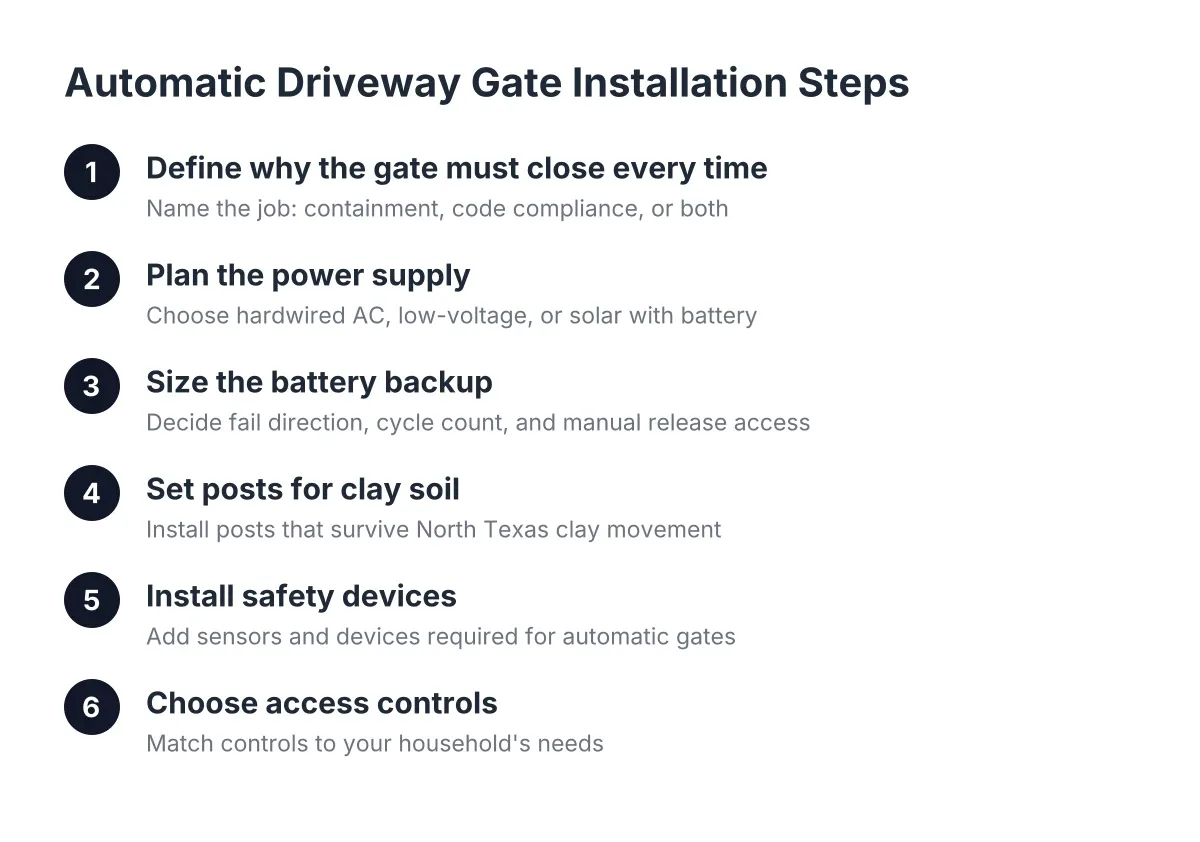
Step 1: Define Why the Gate Needs to Close Every Time
Start by naming the real job the gate has to do. For a dog owner, the job is containment: a gate that latches shut on its own, with no gap at the bottom a determined digger can work under, and no window where the gate sits open while someone carries in groceries. For a homeowner mid-remodel with a new pool, the job is often code compliance; self-closing, self-latching access points are a standard requirement around pools.
This matters because a manual gate fails at exactly the moment you need it. Suppose a Mansfield homeowner with a new rescue dog has a solid cedar privacy fence on three sides and a manual driveway gate on the fourth. The fence never fails. The gate gets left open by a delivery driver once a month, and that is the escape route. An automatic gate removes the human step, which is the weak link in most pet containment setups.
There is research behind the physical-barrier approach. A dog-containment study found a 23% escape rate for physical fences versus 44% for electronic fences, according to Starinsky, Lord, and Herron (2017) in JAVMA. A real gate that actually closes beats an invisible boundary. The gate just has to close on its own.
Step 2: Plan the Power Supply Before Anything Else
Power is the first hard decision in any automatic driveway gate installation, because it dictates trenching, cost, and what the opener can do. You have three broad options:
- Hardwired AC power. A dedicated circuit run from your panel to the gate, usually in buried conduit. This is the most reliable option and supports heavier gates and frequent cycling, but it means trenching, an electrician, and often a permit for the electrical work.
- Low-voltage power. A transformer near the house steps power down, and a smaller wire runs to the gate. Easier to trench, but distance limits apply; long runs lose voltage and can starve the opener.
- Solar with battery. A panel charges a battery that runs the opener. No trenching, which is attractive on long rural driveways. The trade-off is cycle limits; a solar gate that opens thirty times a day during a backyard remodel, with pool contractors coming and going, can outrun its charge.
Measure the distance from your electrical panel to the gate location early. On a quarter-acre to one-acre Mansfield lot, that run can be long enough that trenching becomes a real line item. In North Texas clay, trenching is also seasonal work in practice; the same soil that shifts with moisture swings is hard as fired brick in August and soup in May. Plan the trench alongside any other digging your remodel already requires, such as pool plumbing or patio footings, and you dig once instead of twice.
Understanding the Cost of Automatic Driveway Gate Installation
The cost of an automatic driveway gate installation depends on the gate's weight and length, the opener type, how far power has to travel, and which safety and access devices you add. Trenching distance and site conditions move the number more than the opener brand does. We will not invent a price here; the honest answer is that the power run and the gate itself usually cost more than people expect, and the opener hardware less.
For context on the category, the global automatic gate opening system market was estimated at $2.8 billion in 2025, according to Research and Markets. These systems are mainstream residential equipment now, not estate hardware. If you are budgeting a full project, remember the gate rides on the fence; a wood fence cost calculator can rough out the fence line, but the gate, opener, power run, and safety devices are a separate budget on top of it.
Step 3: Size the Battery Backup for Texas Weather
Battery backup is not optional in North Texas; treat it as part of the core system. Ice storms and summer grid strain both knock out power here, and a dead opener fails in one of two ways: locked shut with your car inside, or drifting open with your dog outside. Neither is acceptable.
When you spec the backup, decide three things:
- Fail direction. Should the gate open or stay closed when power dies and the battery runs out? For pet containment, fail-closed with a manual release is usually right. For a gate that is your only vehicle access, think hard about being locked in during an outage.
- Cycle count. A backup battery is rated for a number of open-close cycles, not hours. A household that cycles the gate ten times a day drains a backup faster than one that cycles it twice.
- Manual release access. Every opener has a manual release. Know where it is, keep the key or tool somewhere findable, and make sure the release does not leave the gate swinging free where a dog can push through it.
Heat matters too. Batteries age faster in enclosures that bake through a Mansfield summer, so mounting location and ventilation affect how long the backup actually lasts. A battery that tested fine in spring can be half-dead by September.
Step 4: Set Posts That Survive Clay Soil
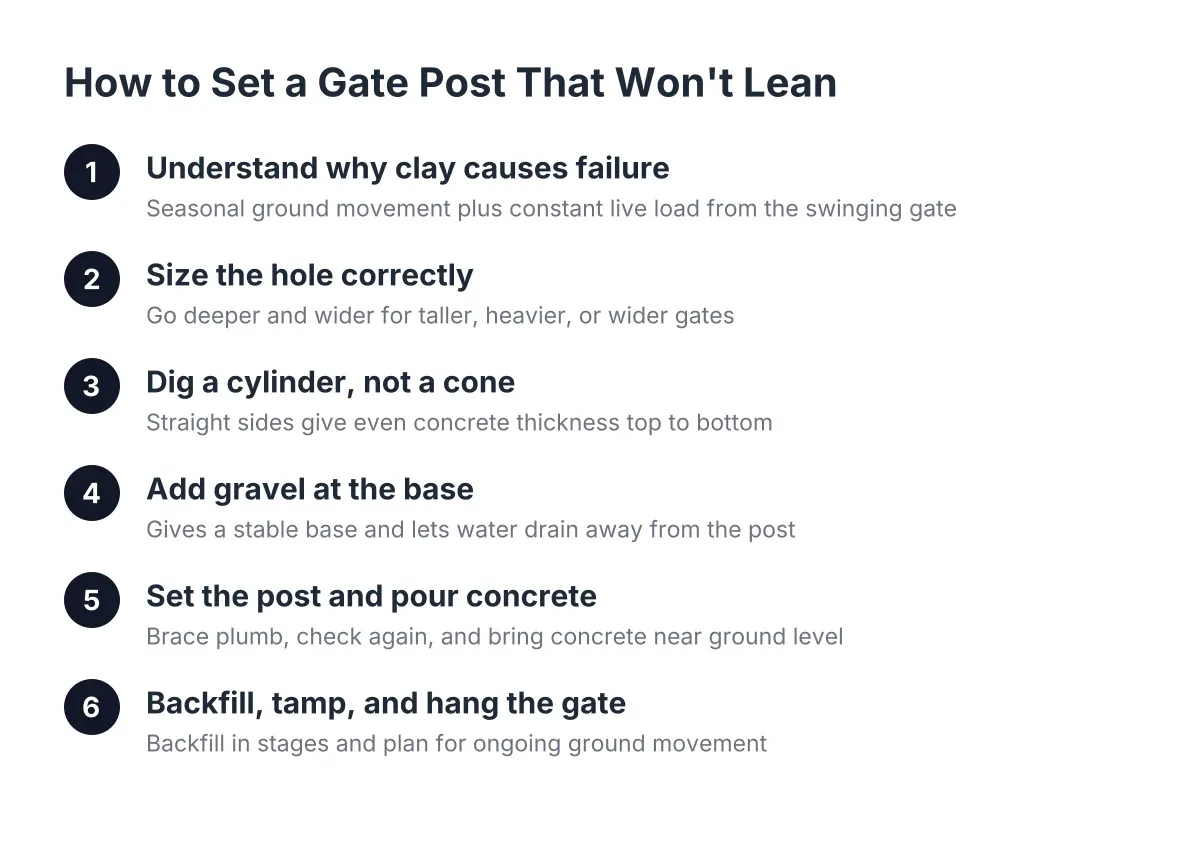
An opener can only move a gate that still hangs straight, and in Mansfield that is a foundation problem. North Texas clay swells when it rains and shrinks when it bakes, and that seasonal movement works on gate posts year after year. A gate post carries far more load than a fence post; the opener adds its own force every cycle.
Pay attention to how the concrete footing is finished. A common installation mistake is stopping the concrete a couple of inches below grade and backfilling with dirt or sod. That traps moisture right where the post meets the ground, and it becomes the most common failure point over time. The concrete should be finished to shed water away from the post, not collect it.
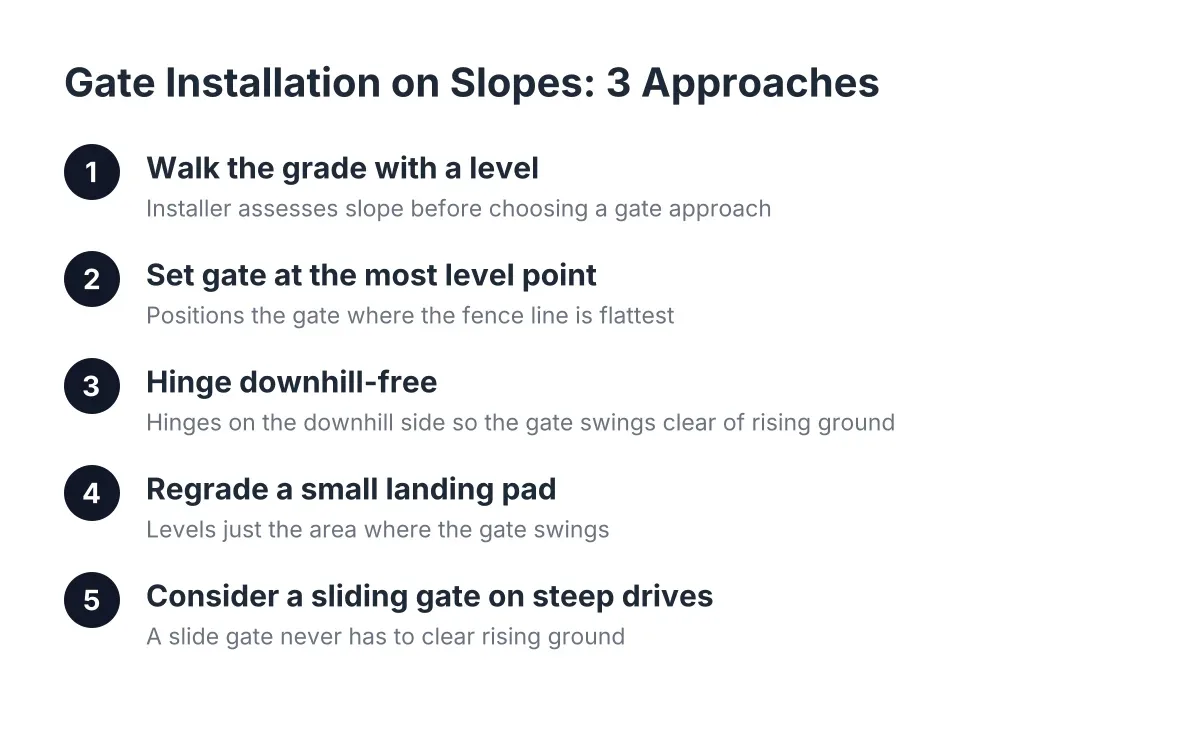
Hard surfaces complicate layout too. Driveways almost always have a pitch for drainage, so installers run a string line across the post tops to keep consistent height above grade. On a sloped drive, that string line is also what keeps the gap under the gate uniform, which matters enormously if the goal is keeping a dog in. A gate that clears the high side of the driveway by a safe margin can leave a crawl-under gap on the low side if nobody planned for the slope.
Step 5: Install the Safety Devices for Automatic Gate Installation
Safety hardware is the part of automatic driveway gate installation that homeowners skip most often, and it is the part that protects kids, pets, and cars. As of 2026, standard practice for residential automated gates includes layered protection, not a single sensor. The core devices:
- Photo eyes (photoelectric sensors). An infrared beam across the gate path that stops or reverses the gate if something breaks the beam. Mount height matters; a beam set for car bumpers can pass right over a dog.
- Inherent obstruction sensing. The opener itself senses resistance and reverses. This is built into reputable openers; verify it works after installation by testing with an object, never a person or a pet.
- Edge sensors. Pressure-sensitive strips on the gate's leading edge and pinch points, especially important on sliding gates where the gate travels along a track.
- Warning signage and entrapment zone clearance. Automated gates are vehicle gates, not pedestrian gates; standard practice is a separate walk gate so people and dogs never pass through the moving one.
So what are the downsides of automatic gates? Honestly: they add moving parts, they need power and periodic testing, and a badly installed one is more dangerous than no opener at all. A gate with no photo eyes, or eyes mounted too high to see a child or a dog, is a hazard dressed up as a convenience. This is also the step where professional help earns its cost; an installer who tests entrapment protection and sets sensor heights for your actual household, pets included, is doing work most homeowners do not know to check.
Step 6: Choose Access Controls That Match Your Household
Next, decide how the gate knows when to open. Options range from simple remotes to keypads, smartphone apps, vehicle sensors, and intercoms. For the pet-focused household, the critical setting is the auto-close timer. A gate that closes itself after a set delay, every time, is what turns the system into reliable pet containment. Set the delay long enough for a car to clear, short enough that a dog does not have a standing invitation.
For a remodel household with contractors on site, temporary access codes beat handing out remotes. You can issue a code for the pool crew and delete it when the project wraps.
Step 7: Test, Then Put the Gate on a Maintenance Rhythm
Finally, test everything before you trust it. Run the gate through full cycles. Break the photo eye beam mid-close and confirm the reverse. Pull the power and confirm the battery takes over. Check the gap under the gate along its entire travel, on your knees, at dog height. Then re-test twice a year, because clay movement, heat, and hardware wear all change the picture between seasons.
Watch for the early warning signs between tests: a gate that hesitates, drags at one point in its swing, or needs two tries to latch. Those are post-movement and alignment problems announcing themselves, and they are cheaper to fix early. Professional gate installation gets the system right on day one, but in this soil, no gate is truly install-and-forget.
One honest limitation: if your existing fence posts are already heaving or your driveway slopes sharply at the gate line, an opener will not fix that, and bolting one onto a failing gate wastes money. Sort out the posts and the fence line first. The opener is the last piece of the system, not the first.
If you need gate installation, Mansfield TX Fence Pros can help.
Prefer to talk it through? Call (817) 383-9360 — a quick call is usually the fastest way to get a straight answer for your situation.