How to Convert an Existing Fence Section Into a Gate: Costs, Structure, and Permits
If your dog needs a second way out of the backyard, or you want direct access to the side yard without walking around the house, you may not need a whole new fence run. In many cases you can convert a fence section into a gate by using an existing fence opening. The fence panel becomes the gate, the posts beside it become the hinge and latch posts, and the job is done in a day or two instead of a week. But it only works if the structure can handle it. This guide walks through the process step by step, including what it changes structurally, what drives the cost, and when Mansfield requires a permit.
This matters most for two kinds of owners. The first is the dog owner whose current fence has gaps the dog squeezes through, especially around gates where hardware and clearance leave openings. The second is the large-lot owner who wants a secure perimeter with a working access point, sometimes a metal gate driveway entrance with an opener down the line. Both need the same thing: a gate that hangs square, closes tight, and does not sag into a gap by next summer.
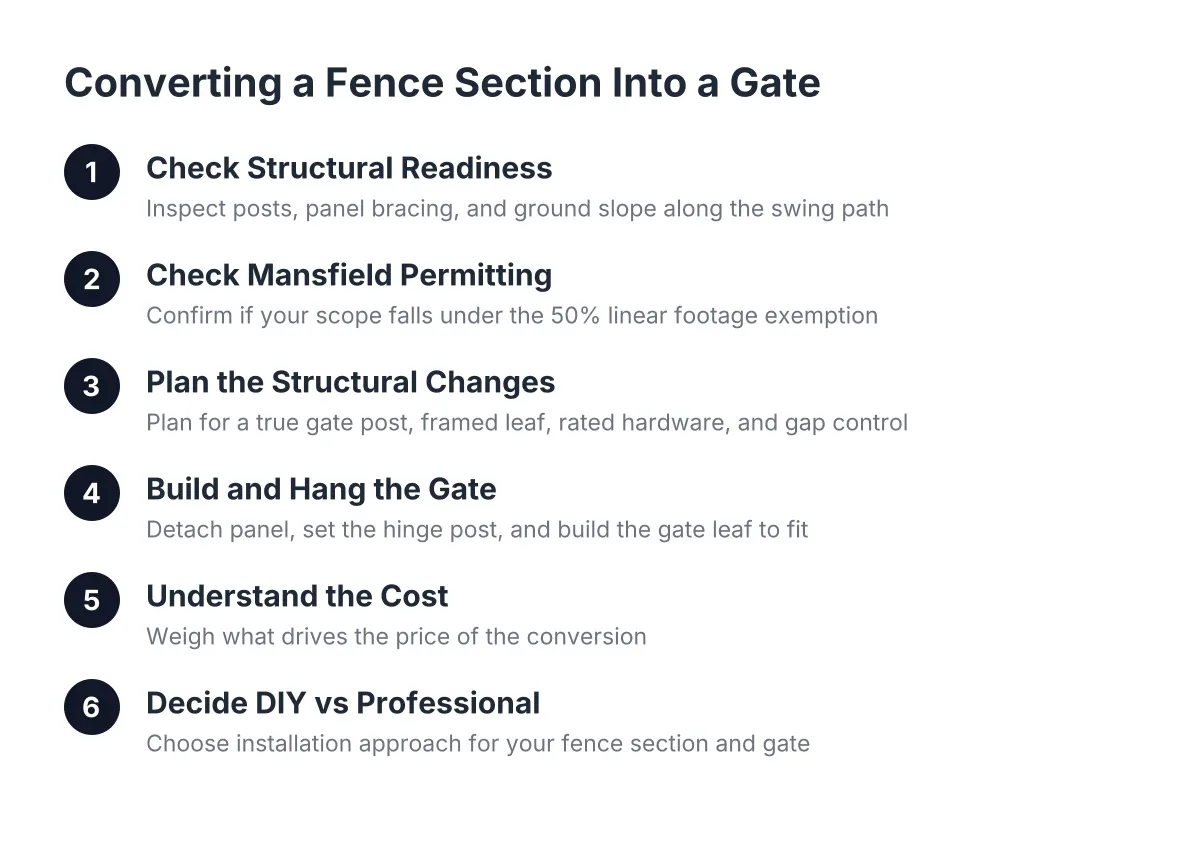
Step 1: Converting a Fence Section Into a Gate — Structural Readiness
Not every fence section converts well. Before you cut anything, check three things: the posts, the panel, and the ground.
The posts matter most. A gate puts constant pulling force on its hinge post, which a fence post never experiences. A standard wood fence post set for holding pickets will lean under gate weight, especially in North Texas clay that swells with spring rain and shrinks hard in August. If the posts flanking your chosen section wobble when you push them, they will not carry a gate.
Next, look at the panel itself. A standard privacy fence panel has no diagonal bracing, so it will rack into a parallelogram once it hangs from hinges. Converting it means adding a frame, not just hardware. Vinyl panels need extra attention here; hollow vinyl uprights do not hold screws well on their own, and installers often add an internal channel insert so the hinge screws bite into something solid.
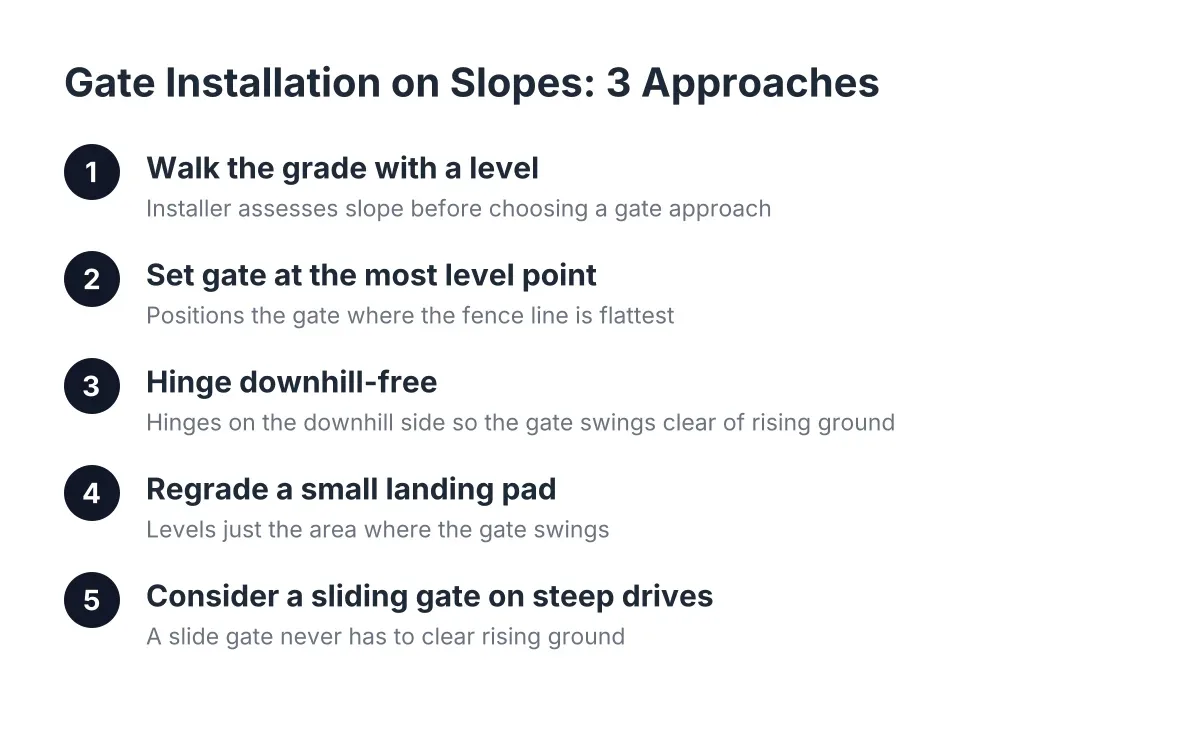
Finally, check the ground along the swing path. A gate needs level clearance through its full arc. If the yard slopes, the gate either drags at one end or leaves a growing gap at the other. For a dog owner, that gap is the whole problem. A dog-containment comparison study found escape rates of 23% for physical fences, according to Starinsky, Lord, and Herron (2017) in JAVMA, and gates are the weakest point of most physical fences. On a slope, plan for a stepped bottom rail or a ground-level barrier under the swing.
Step 2: Check Mansfield Permitting Before You Start
Do you need a permit to convert a fence section into a gate in Mansfield? Often no, but it depends on scope. City of Mansfield building code exempts replacement or repair of an existing wood privacy fence from permitting when the work covers less than 50% of the total linear footage of fencing on the property. Converting one section into a walk gate usually falls well under that threshold.
However, the exemption gets less clear when you change more than you repair. Adding a new driveway gate opening, moving posts, changing fence height, or adding electric gate automation can trigger permit review. HOA rules in many Mansfield neighborhoods also regulate gate placement and appearance separately from the city. As of 2026, the safest move is a quick call to Mansfield's building department with your specific scope before you dig or cut. Five minutes on the phone beats redoing work.
Step 3: Converting a Fence Section Into a Gate — Plan the Structural Changes
Here is what people miss about converting a fence section into a gate project: the panel is the cheap part. The structure around it is where the real work lives. Plan for these changes:
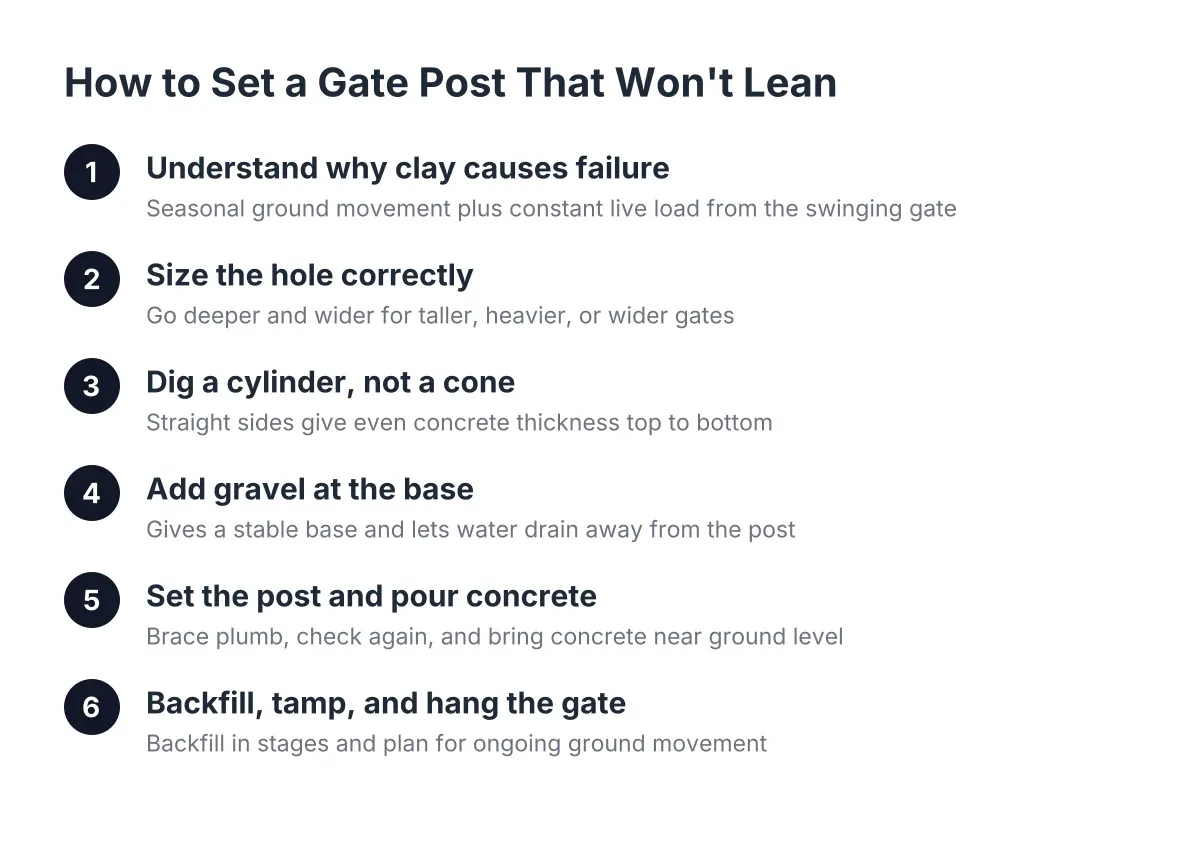
- A true gate post on the hinge side. This usually means pulling the existing post and setting a heavier one, often a steel post, in a deeper and wider concrete footing. Clay soil movement works gate posts loose faster than fence posts because the load swings.
- A framed and braced gate leaf. The panel gets a perimeter frame plus a diagonal brace running from the bottom hinge corner up to the top latch corner, or an anti-sag cable kit doing the same job.
- Hardware rated for the weight. Light strap hinges sag under a solid cedar privacy panel. Heavy-duty hinges and a self-closing latch cost more and are worth it, especially for pet containment.
- A latch-side post that holds alignment. If the latch post drifts even slightly, the latch stops catching and the gate swings open in wind. For a dog proof fence, a latch that fails quietly is the worst failure.
- Bottom gap control. Set the gate clearance tight, and add a concrete mow strip, a buried board, or a threshold under the swing if your dog digs.
One practical note from how experienced crews handle fences: a mixed steel-and-wood approach, where existing steel posts stay and carry the gate load, often ends up stronger against wind and sag than new wood posts alone. If your fence already has steel posts, converting a section between two of them is the easiest path.
Step 4: Build and Hang the Gate
With permits confirmed and structure planned, the build itself follows a clear sequence.
First, detach the chosen panel from its posts. Keep it intact; the pickets will go back on the new frame so the gate matches the rest of the fence.
Second, set or reinforce the hinge post. Dig below the old footing depth, set the post plumb in fresh concrete, and let it cure fully before hanging weight on it. Rushing the cure is the most common reason a new gate leans within a month. In tight spots, such as where the fence butts against a neighbor's fence or a tree, crews sometimes sleeve a vinyl or wood post over a steel pipe for strength without changing the look.
Third, build the gate leaf slightly smaller than the opening. You need clearance on the hinge side for hardware and on the latch side for seasonal post movement. In Mansfield's clay, posts shift with moisture swings, so a gate built with zero clearance binds in wet months.
Fourth, install the diagonal brace, hang the gate on its hinges, and check the swing through the full arc. Then mount the latch, and test it the way a dog would: push, bump, and lean on it. A spring-loaded, self-closing latch mounted high solves most pet escape problems at the gate.
Step 5: Understand What the Conversion Will Cost
How much does it cost to turn a fence section into a gate? Less than adding a new opening from scratch, because you reuse the panel and one or both posts, but more than most homeowners expect, because the hidden cost is structural. The main cost drivers are hardware quality, how much post work the conversion needs, gate width, and material. A walk gate in an existing wood fence sits at the low end. A wide driveway gate with new steel posts sits far above it.
For scale, suppose a Mansfield homeowner on a half-acre lot wants to convert one eight-foot cedar privacy section into a double gate for mower access. In that scenario, the panel and pickets are already paid for; the budget goes to two reinforced posts, two framed leaves with braces, four heavy hinges, a drop rod, and a latch. The labor is mostly digging, concrete, and alignment, not carpentry.
Material matters too. Fence pricing reflects construction style and expected longevity, not just raw lumber cost, and the same holds for gates. For context on fencing generally, the average cost to install a fence is $23 per linear foot, with a typical range of $6 to $50 per linear foot depending on material and labor, according to HomeAdvisor. Gates run higher per foot than fence because of the framing and hardware, which is exactly why converting an existing section appeals: you skip part of that premium.
If automation is on your roadmap, plan the structure for it now. An automatic sliding gate opener or swing operator needs a gate that is rigid, square, and hung on posts that do not move, plus power run to the opening. The market tells you how common this upgrade has become; the global automatic gate opening system market was estimated at $2.8 billion in 2025, according to Research and Markets. Building the conversion opener-ready costs little extra today and saves a rebuild later.
Step 6: Decide Between DIY and Professional Installation for Your Fence Section and Gate
Should you convert the fence section yourself or hire a fence company? It depends on the gate's job. A light walk gate in a sound wood fence is a reasonable weekend project for someone comfortable with concrete and a level. A gate that must contain a determined dog, secure acreage, or carry an opener is a different risk profile, and professional gate installation earns its cost there.
The honest trade-off: DIY saves labor cost but puts alignment, post depth, and gap control on you, and those three details are where converted gates fail. A sagging gate with a two-inch bottom gap is not a gate problem to your dog; it is an exit. If your soil is heavily shifted clay, your fence posts are already leaning, or you plan to automate, bring in a professional to assess the structure before you commit. The same goes for vinyl fence conversions, where internal reinforcement makes the difference between a gate that lasts and one that pulls apart at the screws.
Quick Reference: Converting an Existing Fence Section to a Gate
- Confirm the flanking posts are solid; upgrade the hinge post in almost every case.
- Verify permit scope with the City of Mansfield; minor wood fence work under the 50% linear footage threshold is typically exempt, but new openings and automation may not be.
- Frame and diagonally brace the panel; never hang an unbraced privacy panel.
- Build in clearance for seasonal clay movement, then control the bottom gap with a mow strip or threshold.
- Use self-closing, dog-tested latch hardware if pet containment is the goal.
- If automation is likely, size posts and power for it during the conversion, not after.
Done right, a converted gate looks like it was always part of the fence and holds up to Texas heat, clay movement, and a dog who tests it daily. Done wrong, it becomes the one section of fence you fix every year. The difference is almost entirely in the posts, the brace, and the planning you do before the first cut.
If you need gate installation, Mansfield TX Fence Pros can help.
Prefer to talk it through? Call (817) 383-9360 — a quick call is usually the fastest way to get a straight answer for your situation.