Rolling Gate vs. Swing Gate: Which Works Best in Mansfield’s Clay Soil?
If you are weighing rolling gate vs swing gate options for a Mansfield driveway, the ground under your feet matters as much as the gate itself. North Texas clay soil swells after heavy rain and shrinks hard in August heat. That movement stresses posts, hinges, and tracks differently depending on which gate style you choose. This comparison walks through both options the way a local gate installer would: operation, soil behavior, space, automation, and upkeep, so you can pick the style that keeps working through a Mansfield summer and the occasional ice storm.
This matters whether you are starting fresh or replacing a gate that just failed. Maybe your old swing gate dropped at the hinge and now drags the concrete. Maybe you are mid-pool-build and the permit requires code-compliant fencing with a self-closing gate before the inspector signs off. Either way, choosing the right style for this soil is what keeps you from doing this again in three years.
How Rolling Gates and Swing Gates Operate
A swing gate works like a door. It hangs on hinges mounted to a post and arcs open, either as a single leaf or a double leaf that meets in the middle. A rolling gate, often called a sliding gate, moves sideways along the fence line. It rides on a ground track, or on a cantilever system that suspends the gate so nothing touches the driveway.
The operating difference drives everything else in this comparison. A swing gate concentrates all its weight on one or two hinge posts. A rolling gate spreads its weight across rollers or a cantilever counterbalance, but it demands a straight, clear run of fence line to slide along.
For Mansfield properties, that distinction is not academic. Our clay moves. The question is which gate style tolerates that movement with the least drama.
How Mansfield Clay Soil Treats Each Gate Style
Clay soil in Mansfield expands when soaked and contracts when baked, and it treats each style differently. Swing gates suffer most when a hinge post heaves or leans, because even slight post movement throws off the latch alignment. Rolling gates on a ground track suffer when the track itself shifts or collects silt after heavy rain.
What Happens to a Swing Gate When Posts Move
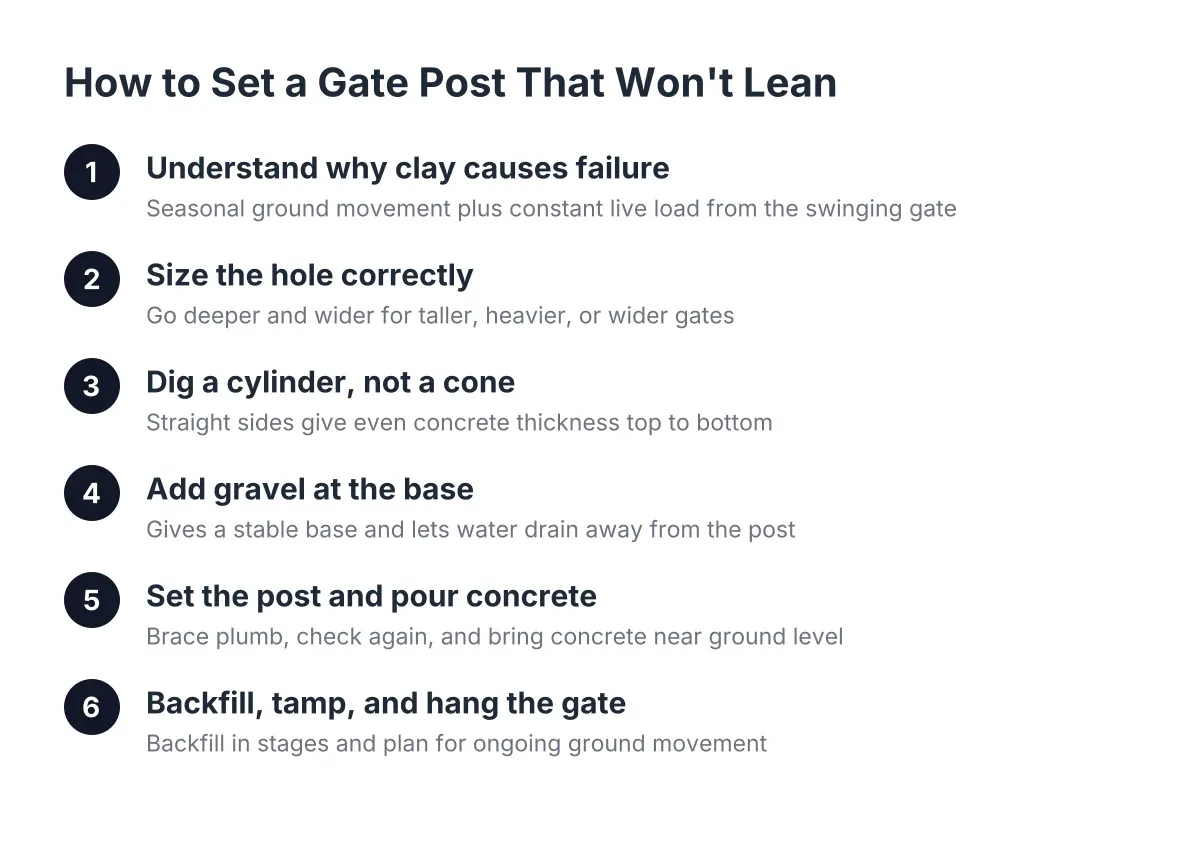
A swing gate is only as good as its hinge post. When seasonal moisture swings push that post even slightly out of plumb, the gate sags, the latch misses its striker, and the leaf drags or binds. If your current gate is stuck open or stuck shut right now, post movement is one of the most common reasons why.
Experienced installers plan for this. Setting the latch striker near the top of its adjustment range gives the gate room to settle and still catch. Deeper footings sized for the gate's weight, not just standard fence-post footings, make the difference between a gate that holds alignment and one that needs a fence repair call every spring.
What Happens to a Rolling Gate on Shifting Ground
A rolling gate with a ground track is vulnerable in a different way. If the concrete pad under the track heaves or settles unevenly, the rollers bind and the gate opener strains. Mansfield's heavy seasonal rain also washes grit into exposed tracks, which grinds rollers down over time.
A cantilever rolling gate sidesteps most of that. The gate hangs from rollers mounted on heavy posts and never touches the ground, so minor soil movement and debris matter far less. The trade-off is that a cantilever gate needs extra fence-line length beyond the opening to counterbalance the gate, plus beefier posts and footings.
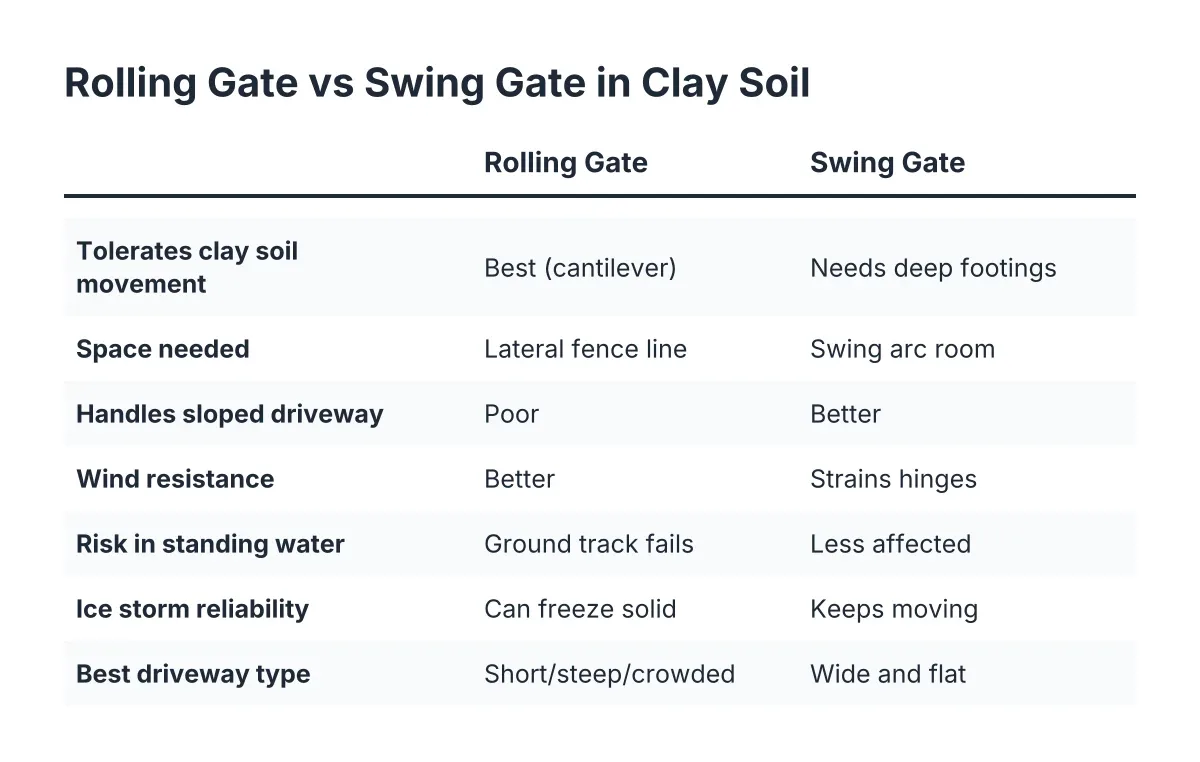
The practical takeaway for clay soil: a well-footed cantilever rolling gate tolerates ground movement better than a ground-track slider, and often better than a wide single-leaf swing gate. However, a properly built swing gate with oversized hinge posts set deep still performs well on most residential driveways here.
Comparing Rolling Gate and Swing Gate Requirements Side by Side
Beyond soil, the two styles differ on space, slope, wind, automation, and maintenance. Here is how they stack up for a typical Mansfield driveway or backyard remodel.
Space and Driveway Layout
- A swing gate needs clear swing room, roughly the width of the opening, either into the property or out toward the street. Swinging toward the street is usually a bad idea on a short driveway because a car waiting to enter blocks the arc.
- A rolling gate needs lateral room, a straight stretch of fence line beside the opening at least as long as the gate itself, longer for cantilever systems.
- Short, steep, or crowded driveways favor rolling gates. Wide, flat entries with room behind the fence favor swing gates.
Slope and Drainage
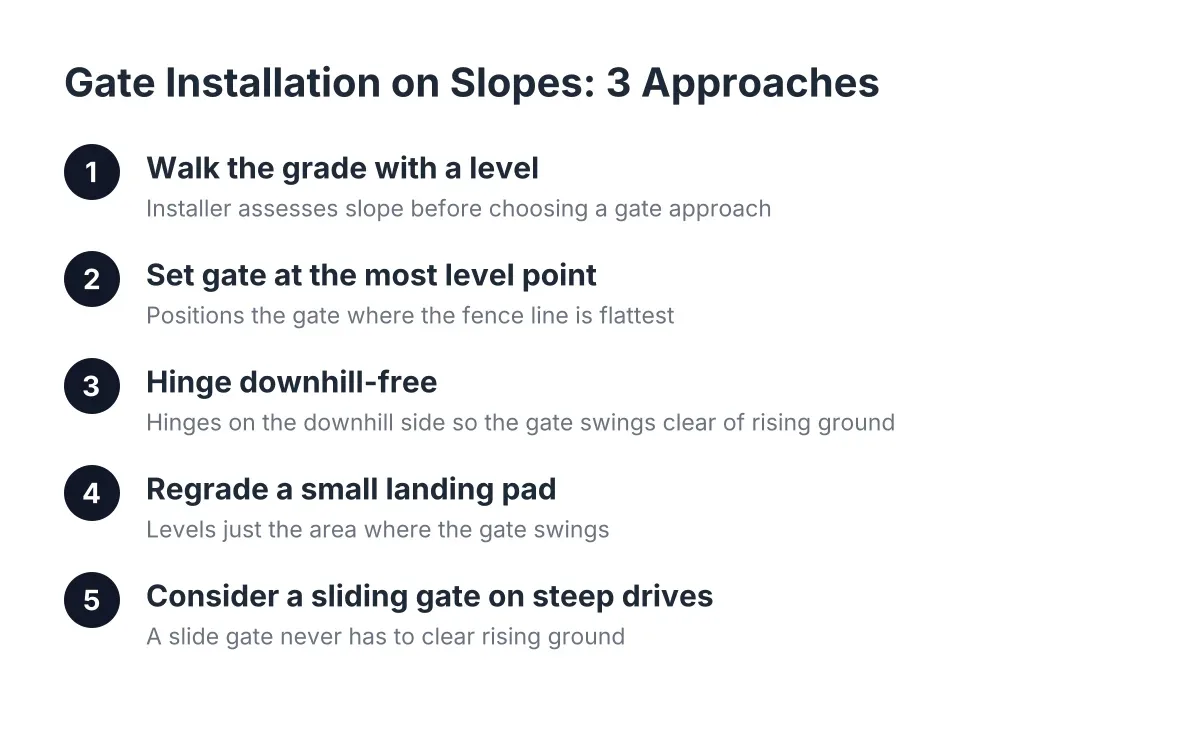
Driveways almost never sit dead level, and a string line across the opening will show you the pitch before you commit to a style. A swing gate can clear a rising driveway by swinging toward the downhill side or by mounting with extra ground clearance. A rolling gate handles slope along the fence line poorly; the track or cantilever path needs to be level even if the driveway is not.
Drainage matters too. Mansfield's heavy rains pool in low spots, and a ground track sitting in standing water fails early. If your entry sits at the low point of the lot, a cantilever rolling gate or a swing gate keeps hardware out of the water.
Wind, Heat, and Ice
North Texas wind loads hit a solid swing gate like a sail, which strains hinges and openers. A rolling gate resists wind better because the panel is supported along its length rather than cantilevered off hinges. For gates with solid cedar or vinyl infill matching a privacy fence, this favors the rolling style on exposed lots.
Heat and ice test materials more than mechanisms. Wood gates swell and shrink with humidity, vinyl softens slightly in extreme heat, and ice events can freeze a ground track solid while a swing gate or cantilever slider keeps moving. If your gate quit working the morning after an ice storm, a frozen or fouled track is a likely suspect.
Automation: Openers for Rolling Gates and Swing Gates
Both styles automate well, and demand keeps growing; according to Research and Markets, the global automatic gate opening system market was estimated at $2.8 billion in 2025. Swing gates use arm-style openers, one per leaf. Rolling gates use a chain- or gear-driven operator, such as a sliding gate opener from LiftMaster or a comparable brand.
A few points matter when choosing:
- Swing gate openers work harder in wind because the arm fights the sail effect. Undersized arm openers on heavy cedar gates burn out early.
- A LiftMaster gate opener or similar slide operator moves the gate at a steady rate regardless of wind, but it depends on a clean, aligned track or cantilever path.
- An electric gate opener kit from a big-box store can run a light gate, but pairing the opener's duty rating to the gate's real weight is where most DIY installs go wrong.
- Safety matters either way. Automated gates near a pool area or play space need proper safety reversal, photo eyes, and clearances, and pool-code fencing rules still apply to the gate itself.
If your existing opener is grinding or the remote stopped responding, the fix is often alignment, a worn gear, or a track obstruction rather than full replacement. A grinding slide operator frequently means the gate has gone heavy on its rollers or the chain has sagged, both fixable. That said, electrical diagnosis on an automated gate is a job for someone who services gate operators, not a general handyman, and an installer should confirm whether your operator brand is still supported before you spend money on parts.
Cost Factors for Each Style
Neither style is automatically cheaper; the site decides. For a swing gate, the big cost drivers are post footings sized for clay soil, gate width and weight, and whether you need one opener arm or two. For a rolling gate, the drivers are the track or cantilever hardware, the concrete work to support it, the extra fence-line length a cantilever needs, and the slide operator.
Site conditions move the number more than the style does. A level entry with good drainage keeps either option simple. A sloped driveway, a low spot that holds water, or a tight lot line adds concrete work, custom fabrication, or regrading. Converting an existing swing gate into a sliding gate is possible, but it usually means new posts, new hardware, and a new operator, so price it against a fresh build rather than assuming conversion saves money.
Material choice matters too. A cedar-clad gate matching a cedar privacy fence weighs more than an aluminum frame with pickets, and weight drives hardware and opener sizing on both styles. During gate installation, an installer should walk the opening with you, check slope with a string line, and flag drainage issues before quoting, because surprises found after the posts are set cost more to fix.
A Mansfield Scenario: Pool Build With a Failed Driveway Gate
Suppose a Mansfield homeowner is mid-pool-build on a half-acre lot. The pool permit requires code-compliant fencing, and in the middle of the project the existing double swing driveway gate sags and stops latching. The driveway rises toward the house, climbs about a car length inside the fence line, and the entry sits near the lot's low drainage path.
In that scenario, a cantilever rolling gate is the stronger fit. The slope kills the inward swing arc, the drainage path rules out a ground track, and the straight run of new vinyl fence going in for the pool gives the cantilever its needed tail room. The failed swing gate's hinge posts, likely heaved by last spring's rains, would have needed replacement anyway. One rebuild solves both problems and matches the new fence.
Flip the terrain, and the answer flips. The same homeowner with a flat entry, good drainage, and no straight fence run beside the opening is better served by a rebuilt double swing gate on deeper, larger footings with top-adjusted latch hardware.
How to Choose Between a Rolling Gate and a Swing Gate
Work through these questions in order, because each one can settle the decision by itself:
- Is there room for the swing arc? If a parked car, slope, or structure blocks the arc, you need a rolling gate.
- Is there a straight fence run beside the opening? No run, no slider. A swing gate is your answer.
- Where does water go? A low, wet entry rules out a ground track; choose a cantilever rolling gate or a swing gate.
- How exposed is the site to wind? Solid privacy-style gates on open lots favor rolling designs.
- How heavy will the gate be? Match hinges, rollers, footings, and opener ratings to real weight, not the opening width.
Both styles work in Mansfield when the footings respect the clay and the hardware matches the gate's weight. The failures you see around town, the sagging swing gate that will not latch and the slider grinding on a silted track, trace back to installation shortcuts, not to the style itself. Pick the style your site dictates, insist on footings and hardware built for ground that moves, and either gate will outlast the opener that drives it.
If you need gate installation, Mansfield TX Fence Pros can help.
Prefer to talk it through? Call (817) 383-9360 — a quick call is usually the fastest way to get a straight answer for your situation.