Gate Opener Maintenance by Season: A North Texas How-To for Heat, Ice, and Rain
An automatic driveway gate in Mansfield lives a harder life than the same gate in a milder climate. Triple-digit summers cook the motor housing, winter ice storms stress hinges and circuit boards, and heavy spring rain soaks into clay soil that swells and shifts the posts the whole system hangs on. That is why seasonal gate opener maintenance on a seasonal schedule matters more here than almost anywhere else. This guide walks you through a step-by-step routine built around North Texas conditions, not a generic national checklist.
Most opener failures we describe below do not start with the motor. They start with the gate itself going out of alignment, usually because the ground moved. If your yard slopes, or your last fence posts leaned within a few years, that history matters for your opener too. The motor is only as healthy as the posts and hinges it has to push against.
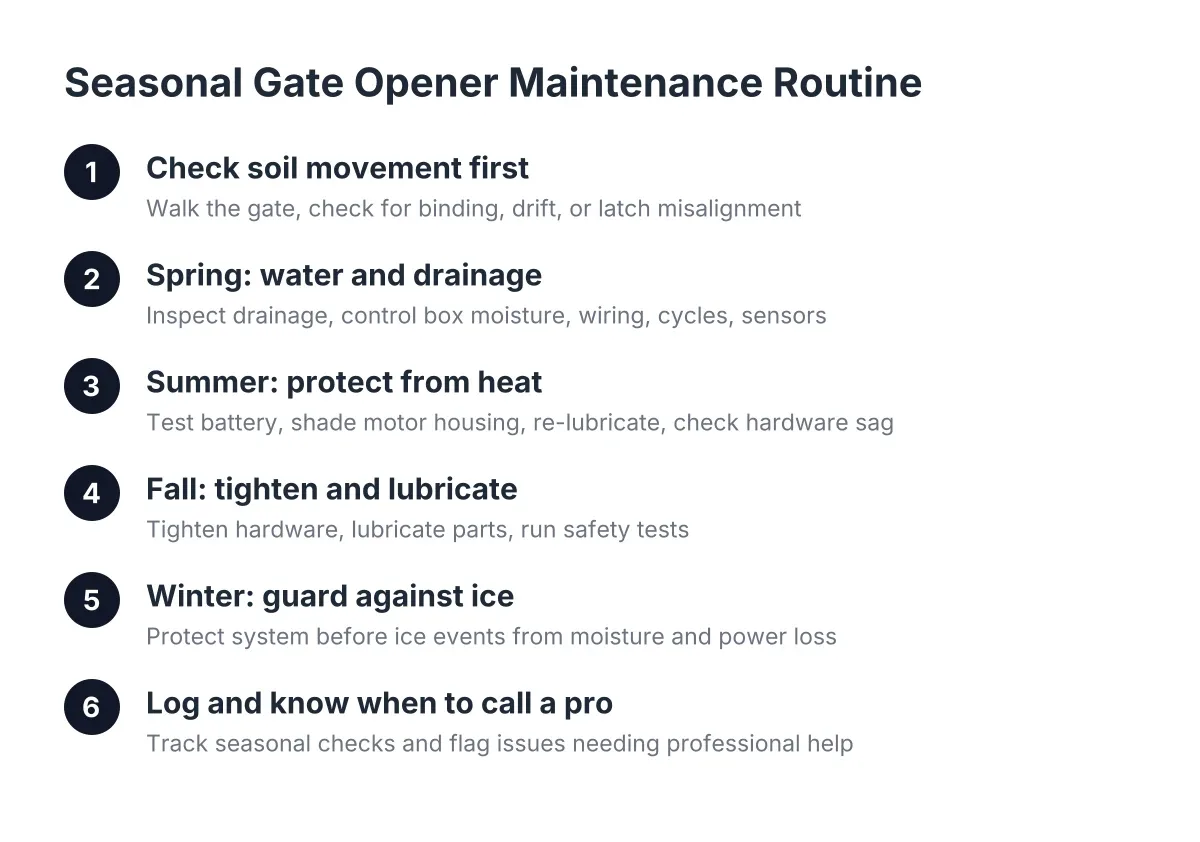
Here is the seasonal rhythm this guide follows:
- Spring (before heavy rain): check post alignment, drainage, and gate swing
- Summer (before peak heat): protect the motor, battery, and electronics from heat
- Fall (before the first freeze): lubricate, tighten, and test safety features
- Winter (before ice events): protect against moisture intrusion and power loss
Work through the steps in order the first time. After that, each season takes an hour or less.
Step 1: Walk the Gate and Check for Soil Movement First
Before you touch the opener, look at what the ground has done since last season. In Mansfield, clay soil swells when it is wet and shrinks when it bakes dry. That cycle pushes on gate posts the same way it pushes on fence posts, and a post that drifts even slightly changes the load on the opener arm every single cycle.
Disconnect the opener using the manual release, then swing the gate by hand. It should move smoothly through its full travel without binding, scraping the ground, or drifting open or closed on its own. A gate that drags at one point in its arc is telling you a post has tilted or heaved.
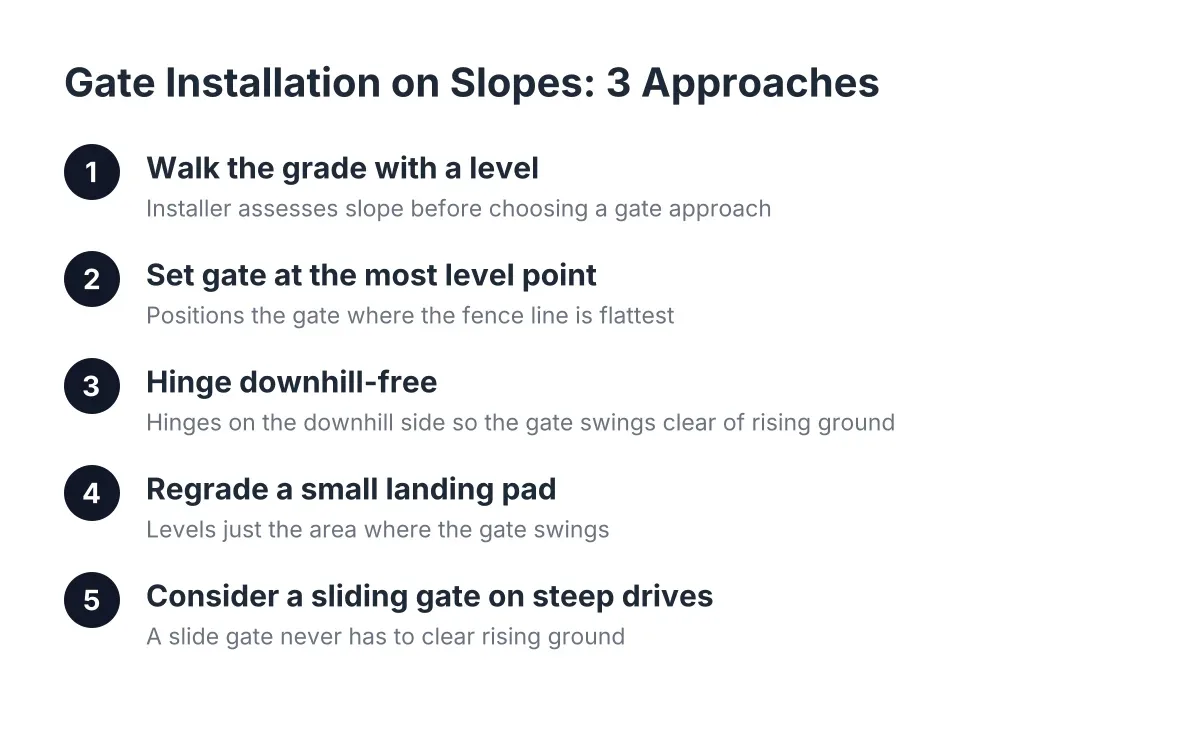
Next, check the latch or stop point. Ground movement often shows up there first; if the gate no longer meets its catch cleanly, the posts have shifted relative to each other. This is common on sloped lots where one post sits in wetter soil than the other.
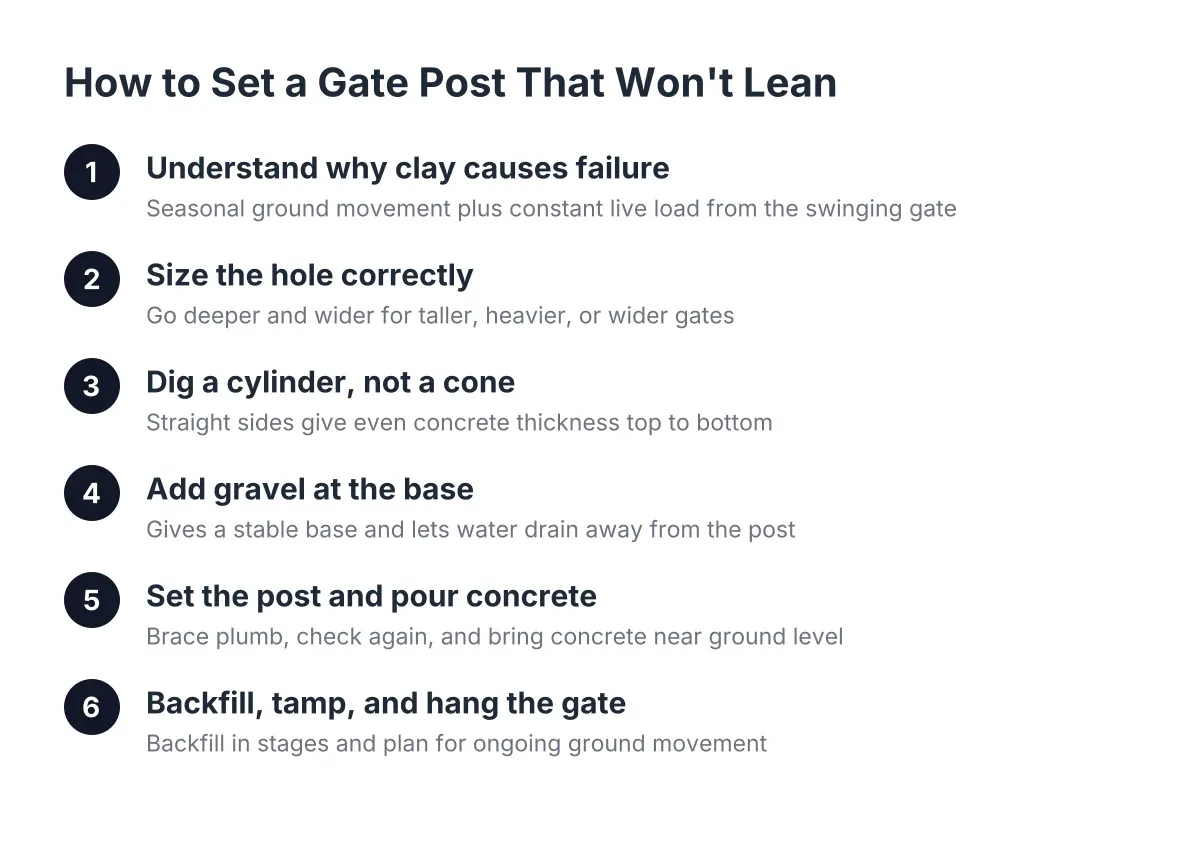
If the gate binds or drags, fix that before servicing the opener. An opener forced to fight a misaligned gate wears out its motor, gears, and arm bushings long before their time. Minor hinge adjustments are a homeowner job. A leaning post set in shifting clay is usually not; resetting it properly may need a deeper footing, and that is worth a professional assessment rather than a guess.
Spring Checks for Seasonal Gate Opener Maintenance
Spring gate opener maintenance in North Texas is mostly about water. Heavy seasonal rain saturates clay soil, and saturated clay is when posts move the most. Rain also finds its way into control boxes, conduit, and loop wiring.
Do these checks in March or April, before the big storms:
- Inspect drainage around both gate posts. Water should flow away from the posts, not pool at the base. Standing water softens the soil and accelerates post lean.
- Open the control box and look for moisture. Check for condensation, rust on terminals, or wasp nests. Reseal any gasket that has cracked in last summer's heat.
- Check buried wiring entry points. Conduit that has heaved out of the ground with the soil can crack and let water reach low-voltage wires.
- Test the gate through ten full cycles. Listen for new grinding, hesitation, or a motor that strains at the same spot each time.
- Clean photo eyes and sensors. Spring pollen in this area coats lenses fast, and a dirty sensor causes random reversals that look like motor failure.
If the opener hesitates after rain but runs fine when things dry out, suspect moisture in a connection or control board before you suspect the motor. Rain-related electrical gremlins are one of the most common complaints with automatic gates in this region.
Summer Heat and Seasonal Gate Opener Maintenance
Mansfield summers punish electronics. Motor housings in direct afternoon sun can run far hotter than the air around them, and heat shortens the life of batteries, capacitors, and circuit boards.
First, check the battery if your opener has a backup. Heat is harder on batteries than cold; a battery that struggled last August will likely fail this one. Test it by cycling the gate on battery power alone with the main power switched off.
Next, look at sun exposure on the control box and motor housing. If the housing sits in full western sun, a simple shade solution helps: a solar panel mount repositioned as a shade, a vented cover, or plantings that block afternoon light without blocking airflow. Keep vents clear; a sealed, baking box cooks its own electronics.
In addition, check lubrication going into summer. Heat thins grease and dries out cheap lubricants. Use the lubricant type your opener manufacturer specifies on chain drives, screw drives, and pivot points. Avoid heavy grease on hinges in dusty conditions, since it collects grit that acts like sandpaper.
Finally, watch the gate hardware itself. Wood and vinyl gates expand and contract with heat. A wood driveway gate that fit perfectly in April can swell or sag by July, and a sagging gate loads the opener arm unevenly. If your gate has an anti-sag brace, confirm it is still tight and pulling in the correct direction; a rigid brace installed backward makes sag worse instead of better.
Why Seasonal Opener Maintenance Beats an Annual Checkup Here
A single annual service works in climates with one dominant stress. North Texas has three: heat, ice, and rain-driven soil movement, and each hits a different part of the system at a different time of year. Spreading gate opener maintenance across the seasons means you catch each stress before it compounds.
For example, a slightly tilted post noticed in spring costs a hinge adjustment. The same tilt ignored until fall has spent a whole summer forcing the motor to drag a binding gate, and now you are pricing a new operator instead of a tube of thread locker. The seasonal approach is cheaper precisely because clay soil never stops moving; it only changes direction.
Step 4: Do the Fall Tighten, Lubricate, and Safety Test
Fall is the mechanical season. Summer heat has loosened fasteners through expansion cycles, and you want everything tight and lubricated before cold weather makes outdoor work miserable.
Work through this sequence in October or November:
- Tighten hinge bolts, bracket bolts, and the opener arm mounting hardware. Check the posts themselves for new movement after the summer dry-out, since shrinking clay lets posts lean just as swelling clay pushes them.
- Lubricate hinges, pivot points, and the drive mechanism per the manual.
- Inspect the opener arm for play at its connection points. Slop here becomes slamming in winter wind.
- Test every safety feature: photo eyes, obstruction auto-reverse, and the manual release. Put a solid object in the gate path and confirm the gate reverses on contact.
- Replace remote and keypad batteries now, before cold weather weakens them.
Say a homeowner on a sloped lot off Matlock Road notices this fall that the gate latch no longer lines up after a dry summer. In that scenario, the smart move is checking which post moved before adjusting anything, because adjusting the opener limits to chase a moving post just hides the real problem until it gets expensive. On lots with known movement, installers sometimes set the latch catch with extra vertical tolerance for exactly this reason, so the gate keeps latching as the ground shifts.
Step 5: Protect the System Before Ice Events
North Texas ice storms are infrequent but destructive. The failure pattern is predictable: moisture gets into a mechanism or connection, freezes, and either jams the gate or shorts the board when it thaws.
Before the first hard freeze, confirm the control box seals tightly and no wiring insulation has cracked. Check that the gate does not sit in a low spot where runoff refreezes under it overnight; an opener trying to break a gate free of ice will trip its obstruction sensing or strip its drive.
During an actual ice event, leave the gate in manual mode if freezing rain is forecast. It is easier to open a gate by hand for two days than to replace a motor that burned out fighting a frozen hinge. Afterward, cycle the gate manually first to confirm free movement before re-engaging the opener.
Step 6: Keep a Simple Log and Know When to Call a Pro
Write down what you find each season, even two lines in a phone note. A log turns vague worry into pattern recognition. If the latch misalignment is new every spring and corrects itself by fall, you are watching seasonal clay movement, which is manageable. If the lean gets worse every year, the post footing is failing, and that needs structural attention, not more opener adjustments.
Automatic gates are a growing category; the global automatic gate opening system market was estimated at $2.8 billion in 2025, according to Research and Markets. More systems installed means more systems aging in hard climates like this one, and the owners who keep a seasonal routine are the ones whose openers reach old age.
Know your limits, too. Homeowners can handle cleaning, lubrication, tightening, battery swaps, and safety tests. Electrical faults, failing footings, structural post work, and anything involving the main drive assembly belong with a professional, both for safety and because a misdiagnosis gets expensive fast. If your gate problems trace back to posts set shallow in clay during the original gate installation, a fence company that understands local soil can tell you whether a reset, a deeper footing, or a different gate style makes more sense than another round of adjustments.
The payoff for an hour per season is real. A well-maintained opener on well-set posts outlasts a neglected one by years, and in Mansfield's climate, the seasons will test every shortcut eventually. Better that your checklist finds the weak point before August heat or February ice does.
If you need gate installation, Mansfield TX Fence Pros can help.
Prefer to talk it through? Call (817) 383-9360 — a quick call is usually the fastest way to get a straight answer for your situation.