Gate Installation for Dog Owners: 8 Ways to Build an Escape-Proof Gate in Mansfield, TX
If your dog has ever slipped through a sagging gate or squeezed under a gap you did not know was there, you already know the gate is the weakest point of any fence. Good gate installation closes that weak point. This guide walks through eight practical checks dog owners in Mansfield, TX should make before hiring anyone to hang an escape-proof gate for dogs, from the gap under the bottom rail to the latch your dog cannot nose open.
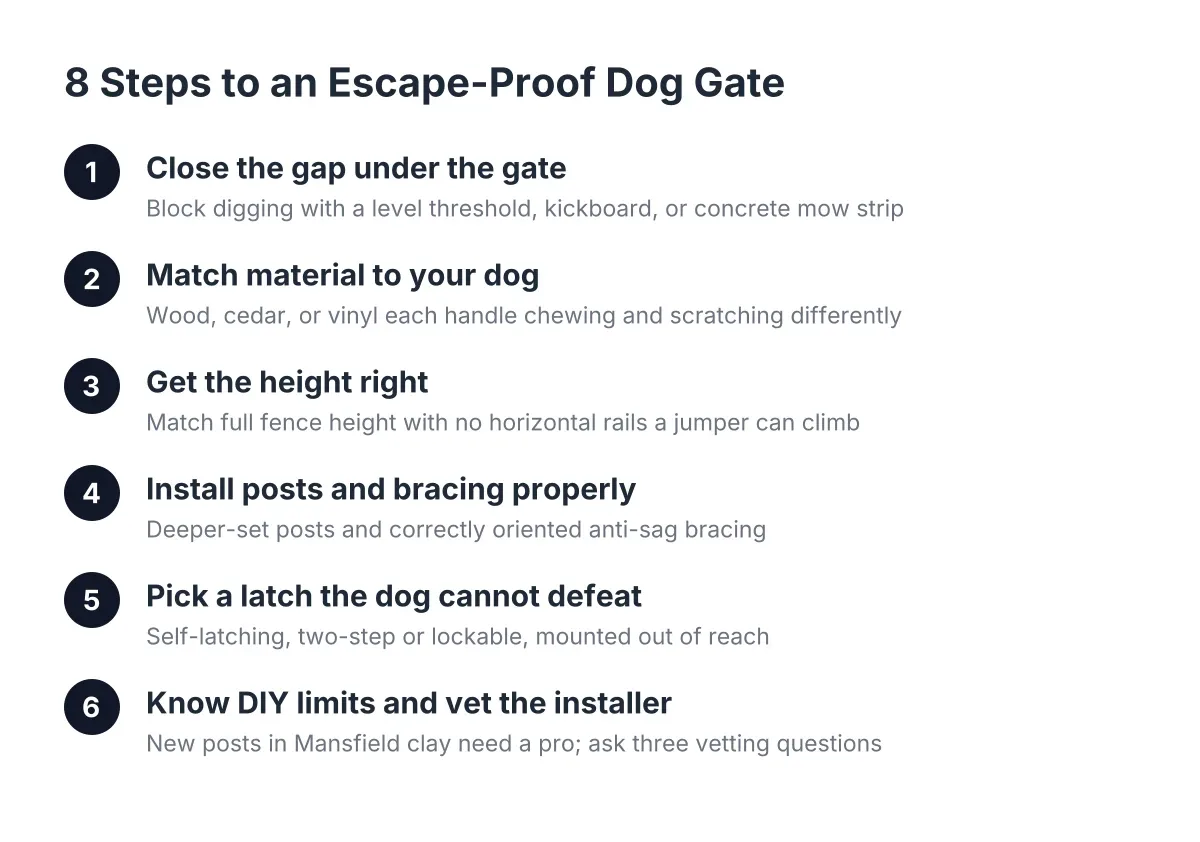
The stakes are real. A dog-containment comparison study found escape rates of 23% for physical fences, compared with 44% for electronic fences, according to Starinsky, Lord, and Herron (2017), JAVMA. A physical fence works better than an invisible one, but only if the gate is built as carefully as the fence around it. Here are the eight things that separate a pet-proof gate from an escape route.
1. Close the Gap Under an Escape-Proof Gate for Dogs First
The space under the gate is the number one escape route for diggers. Ask any installer to measure the clearance at the bottom of the gate opening and tell you how they plan to handle it. A level threshold, a kickboard along the bottom of the adjoining fence, or a concrete mow strip under the gate swing all block a determined digger.
North Texas clay makes this harder than it sounds. Mansfield soil swells when it rains and shrinks in summer heat, so a gate that sits flush in April can show a gap by August. A good installer plans for that movement instead of pretending the ground stays put.
For dogs that dig with intent, ask about a buried barrier or a poured concrete strip directly under the gate. It costs more up front, but it removes the one spot your dog works on every afternoon.
2. Match the Gate Material to Your Dog, Not Just Your Fence
Wood, cedar, and vinyl gates all contain dogs well when built right; the difference is maintenance and how each handles chewing and scratching. A cedar gate on a cedar privacy fence looks seamless and resists rot better than untreated pine, but it needs periodic sealing. Vinyl shrugs off scratching and never needs staining, which matters to owners who want a low-maintenance pet containment fence.
However, vinyl gates have a known weak point: screws pulling out of hollow uprights. The fix is a reinforcing channel insert inside the gate frame that gives screws something solid to bite. If a contractor quotes a vinyl gate, ask whether the frame is reinforced. An unreinforced vinyl gate on a yard with a 70-pound dog leaning on it daily will loosen long before the fence does.
Cost-wise, vinyl typically runs higher than wood up front, while wood costs more over time in staining and fence repair. For broad context, HomeAdvisor puts the average cost to install a fence at $23 per linear foot, with a typical range of $6 to $50 depending on material and labor. Gates price separately because of hardware and framing, so get the gate line-itemed on any quote.
3. Get the Gate Height Right for a Jumper
A gate only needs to be one inch shorter than the fence for a jumper to find it. If your dog clears or climbs, the gate should match the full fence height, usually six feet for a privacy fence, with no horizontal rails on the dog's side that work as a ladder. Smooth-faced vinyl is hard for most dogs to climb for exactly this reason.
Watch the latch-side post too. A gate post set lower than the fence line creates a visual notch some athletic dogs target. Specify that the gate frame and posts run the same height as the surrounding fence, and confirm it in the written quote.
4. What Does Proper Gate Installation Include?
Proper gate installation includes set posts sized for the gate's weight, a framed and braced gate that will not sag, hinges and a latch rated for daily use, and adjustment so the gate swings, closes, and latches cleanly. It should also include cleanup and haul-off of old material. Electrical work for an automatic opener, custom metal fabrication, and concrete flatwork under the gate usually price as extras.
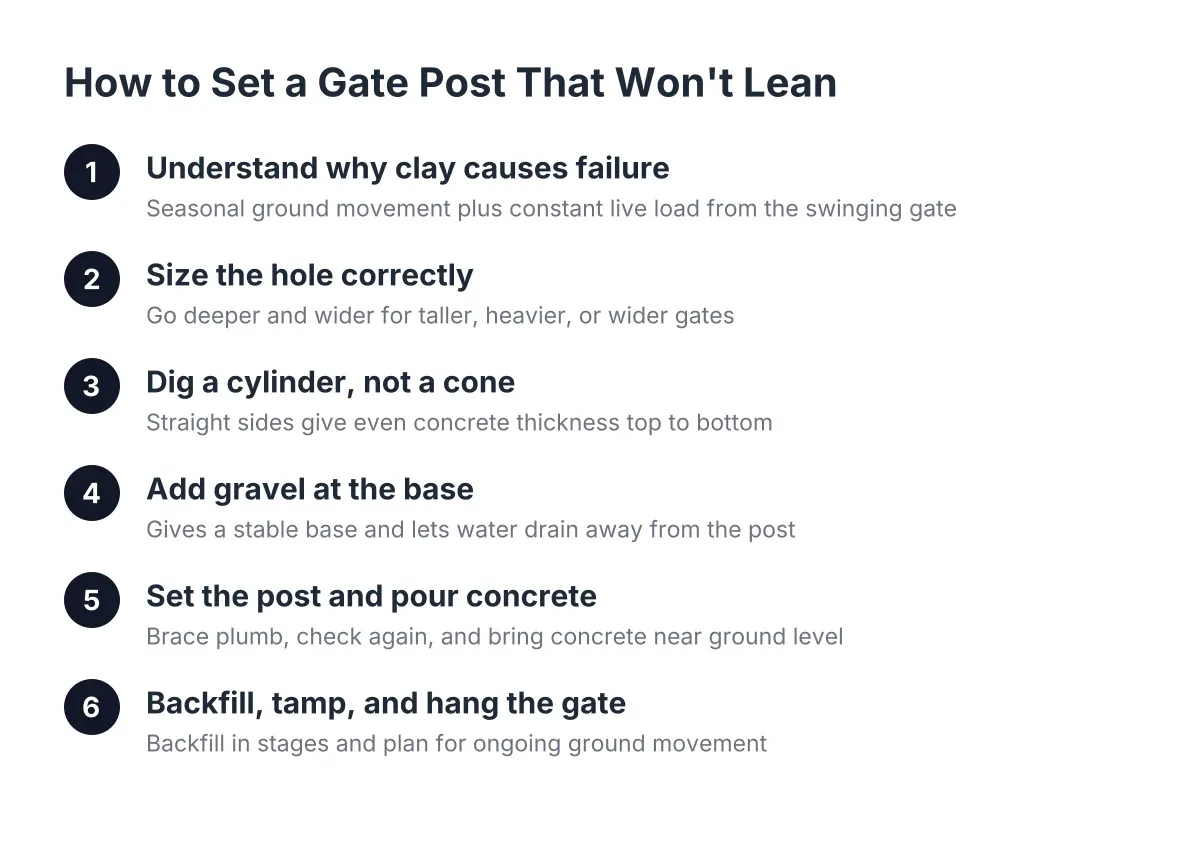
The posts matter more than the gate itself. In Mansfield's shifting clay, gate posts carry constant leverage from the swinging weight, so they need deeper setting and more concrete than a standard fence post. Some installers use a steel pipe core sleeved inside a vinyl or wood post for gates in tight or high-stress spots, such as where the gate butts against another fence.
Bracing direction is a detail most homeowners never check. A rigid anti-sag brace installed backward can speed up sagging instead of preventing it. You do not need to learn the geometry; just ask the installer how they prevent sag and listen for a confident, specific answer.
5. Pick a Latch Your Dog Cannot Defeat
Dogs open gates. A smart lab or a persistent heeler will flip a simple gravity latch with a nose or paw given enough afternoons. Choose a two-step or lockable latch, mounted high enough that the dog cannot reach it, and make sure it self-latches every time the gate swings shut.
Latch placement also fights ground movement. Mounting the striker toward the top of the latch's adjustment range leaves room for the gate to settle as seasonal moisture shifts the posts, so the gate keeps latching through the year instead of drifting out of alignment by fall.
Here is a quick checklist for an escape-proof gate designed for dogs:
- Self-latching, so an open gate is never left unlatched behind a distracted kid or delivery driver
- Two-step or keyed operation a paw cannot trip
- Mounted on the yard-exterior side, out of the dog's reach
- Adjustable striker with room to move as posts settle
6. Know When Gate Installation Is a DIY Job and When It Is Not
A homeowner can swap hinges, replace a latch, or rehang a light gate on sound existing posts. Setting new gate posts in Mansfield clay is a different job. If the posts are not plumb, deep enough, and cured before the gate hangs, the gate sags within a season, and the gap your dog needs opens up at the bottom corner.
Call a professional now if you see any of these warning signs:
- The gate drags the ground or no longer latches without lifting it
- A gate post leans or rocks when you push it
- Gaps at the bottom corner that change size with the seasons
- Hinge screws that keep working loose from the frame
In addition, anything involving an automatic opener means electrical work and safety sensors, which is professional territory. For an HOA or property manager overseeing community access gates across 50-plus units, the calculus is simpler: one failed gate becomes a liability and a board agenda item, so scheduled professional inspection beats reactive repair.
7. Account for Mansfield Conditions and Rules Before You Build
Local conditions decide more about gate design here than style preferences do. Expansive clay soil shifts with seasonal moisture, hot summers bake wood finishes, occasional ice stresses hinges and hardware, and heavy seasonal rain softens post holes. Each of those argues for deeper posts, quality hardware, and a design that tolerates movement.
Rules matter too. As of 2026, the City of Mansfield exempts replacement or repair of an existing wood privacy fence from permitting when the work covers less than 50% of the total linear footage on the property, according to the City of Mansfield, Texas. New gates in new locations, changes to height, or work near easements can trigger review, and HOA architectural approval is a separate step with its own timeline. Confirm both before any posts go in; a gate installed on the wrong side of a property line or easement may have to come out at the owner's expense.
8. Vet the Installer With Three Questions
Suppose a homeowner near Walnut Creek just adopted a digger and gets three bids for a new cedar privacy fence with a walk gate and a driveway gate. In that scenario, the cheapest bid is often the one that skips the details that keep a dog in. Ask every gate installation company these three questions and compare the answers, not just the totals:
- How do you set gate posts differently from fence posts in clay soil, and how long do they cure before the gate hangs?
- What is your plan for the gap under the gate, now and after the ground moves?
- How is the gate braced against sag, and what hardware brand and latch type are you quoting?
A fair quote lists the gate as its own line item, names the materials and hardware, states who handles permits and HOA submittals, and gives a realistic start window. Vague one-line quotes hide the shortcuts. The same logic scales up: an HOA board bidding a community gate or perimeter fence replacement should require this itemization from every bidder so the board compares identical scopes.
One honest caveat: no gate stops every dog. A determined climber or an anxious escape artist may need training, supervision, or yard changes alongside a better fence. A well-built physical barrier closes the easy exits; it does not replace attention.
Automatic Gates and Dogs: A Quick Word
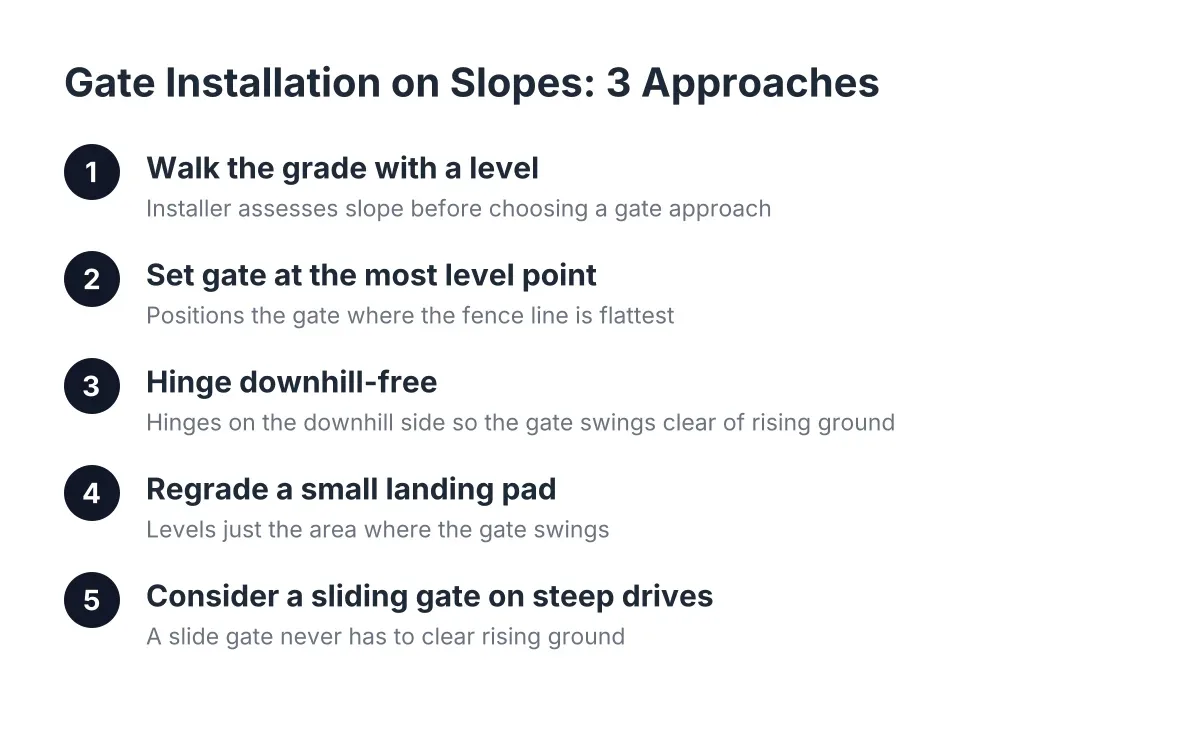
Automatic driveway gates are increasingly common; the global automatic gate opening system market was estimated at $2.8 billion in 2025, according to Research and Markets. For dog owners, the critical features are safety sensors that stop the gate from closing on a pet and a gate design with no pet-sized gap while the gate cycles. Sliding gates often leave a tempting opening along the track, so walk the layout with your installer and your dog's habits in mind.
The downsides are worth weighing honestly. Openers add cost, need seasonal maintenance in North Texas heat and ice, and depend on power unless you add battery backup. For many backyard pet containment setups, a well-built manual gate with a self-latching mechanism does the job with nothing to break.
The Bottom Line for Mansfield Pet Owners
A dog-proof yard comes down to the details at the gate: sealed bottom gap, full-height frame, reinforced construction, a latch the dog cannot work, and posts set for clay soil that moves. Get those five things in writing from whoever you hire, whether it is a single backyard walk gate or a phased community gate project for an HOA.
If you are planning a new fence, a gate for an existing fence, or a driveway gate in Mansfield, Mansfield TX Fence Pros will walk the yard with you, explain what drives the price, and give you a clear, itemized estimate with no invented numbers. Reach out to schedule a site visit and get straight answers before your dog finds the next weak spot.
If you need gate installation, Mansfield TX Fence Pros can help.
Prefer to talk it through? Call (817) 383-9360 — a quick call is usually the fastest way to get a straight answer for your situation.