Gate Installation for Dog Owners: Why the Gate Is Where Most Yards Fail
If your dog has ever slipped out of the yard, there is a good chance the escape route was not the fence. It was the gate. Most conversations about pet containment focus on fence height and digging, but gate installation for dogs is where most backyard enclosures actually fail. A gate is the one moving part in a system that is otherwise standing still, and moving parts wear, sag, and drift out of alignment. In Mansfield, where clay soil shifts with every wet and dry cycle, that drift happens faster than most homeowners expect.
This guide walks through why gates fail, what a dog actually tests, what a well-built gate includes, and how to decide whether to tackle the work yourself or hire a fence company. It is written for the dog owner who has already patched a gap once and does not want to do it again, and for the acreage owner who needs a driveway gate that closes the perimeter instead of being the hole in it.
The Weakest Point in Any Fence Is the Part That Moves
Think about what a fence does all day. Nothing. It stands there. A gate, on the other hand, swings open and shut dozens of times a week. Every swing puts leverage on the hinges, the hinge post, and the latch. Over months, that leverage pulls the gate out of square. The bottom corner drops. A gap opens under the latch side. A determined dog finds that gap in an afternoon.
The physics are simple. A gate is a lever, and the hinge post is the fulcrum. The wider and heavier the gate, the more force it applies to that post every time it moves or hangs closed. Wood gates absorb moisture and get heavier in wet seasons. Vinyl gates flex if the internal frame is weak. Metal driveway gates concentrate enormous weight on two hinge points. None of this is a defect; it is just what gates are. The question is whether the installation anticipated it.
There is also a human factor. Family members, lawn crews, and delivery drivers all use the gate. Someone leaves it unlatched. Someone forces it when it sticks. A fence only has to be built right once. A gate has to keep working right every single day, which is a much higher bar.
Physical fencing is still the most reliable way to contain a dog. A dog-containment comparison study found escape rates of 44% for electronic fences versus 23% for physical fences, according to Starinsky, Lord, and Herron in JAVMA. But that 23% has to come from somewhere, and in a physical fence, the gate is the most common point of failure. Fix the gate and you fix most of the risk.
How Dogs Actually Test a Gate
Dogs do not escape randomly. They probe. A dog that spends hours in the yard learns every weak point along the perimeter, and the gate offers more weak points than any stretch of fence. Here is what a dog actually works on:
- The gap under the gate. Gates need ground clearance to swing, which means a gap. If the ground slopes or erodes, that gap grows. Diggers start where the digging is already half done.
- The gap at the latch side. A sagging gate pulls away from the latch post, leaving a vertical gap a slim dog can wedge through or widen by pushing.
- The latch itself. Smart dogs learn to flip gravity latches with a nose or paw. A latch that does not positively lock is a suggestion, not a barrier.
- The hinge side. Loose hinges let a gate rack and flex. A dog pushing on a flexing gate can open a surprising gap at the corners.
- Spring-back. A gate without a self-closing mechanism stays open every time a person forgets. The dog does not need to defeat anything; the door was left open.
Suppose a homeowner in Mansfield adopts a sixty-pound shepherd mix and the existing wood fence has a gate that drags on the ground. The owner shims it, props a paver against the gap, and it holds for a few weeks. Then a wet spring swells the gate, the owner plates it open to stop the dragging, and one afternoon the dog is gone. In that scenario, nothing about the fence failed. The gate did, in three small steps that each seemed manageable at the time.
The lesson: pet containment is a gate problem first and a fence problem second. When you plan a privacy fence or evaluate the one you have, start your inspection at the gate.
What Good Gate Installation for Dogs Includes
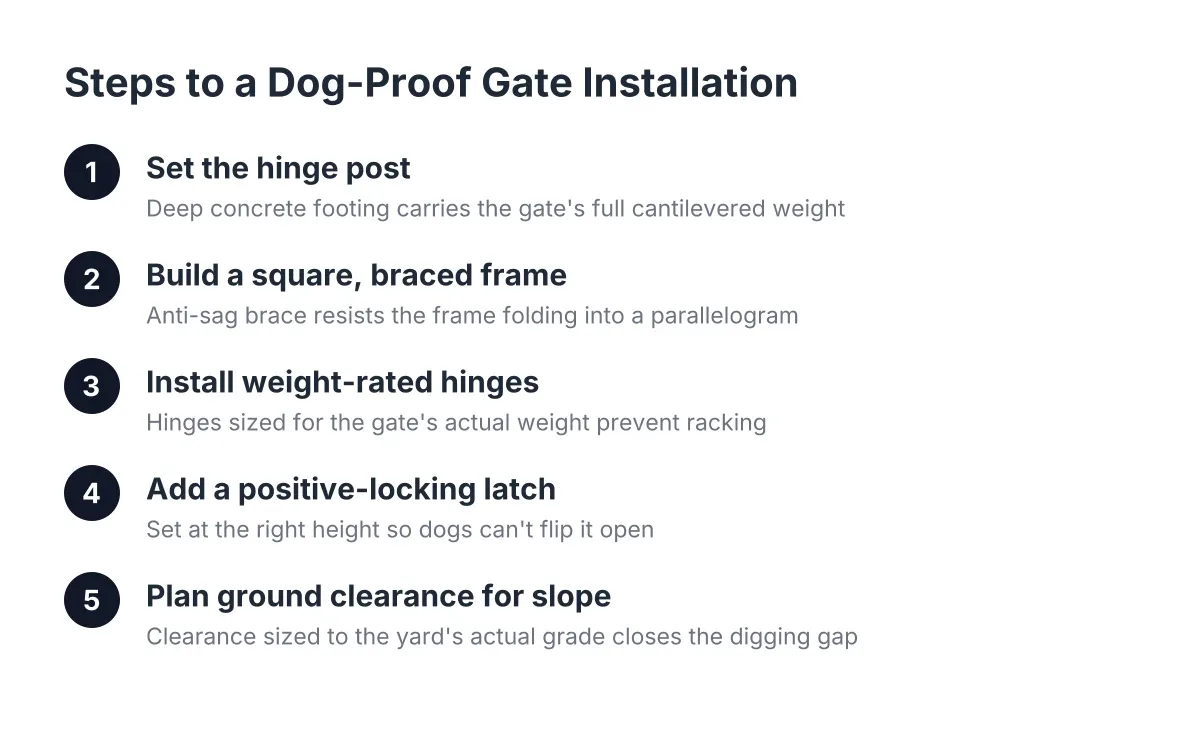
Professional gate installation for dogs covers more than hanging a panel on hinges. A proper scope of work includes the hinge post set deep in concrete, a gate frame built square and braced against sag, hinges rated for the gate's weight, a positive-locking latch set at the right height, and ground clearance planned for the actual slope of the yard. Items like automation, electrical work, and custom metal fabrication are usually priced separately.
Each of those pieces deserves a closer look, because each one is a place where shortcuts show up months later.
The hinge post carries everything
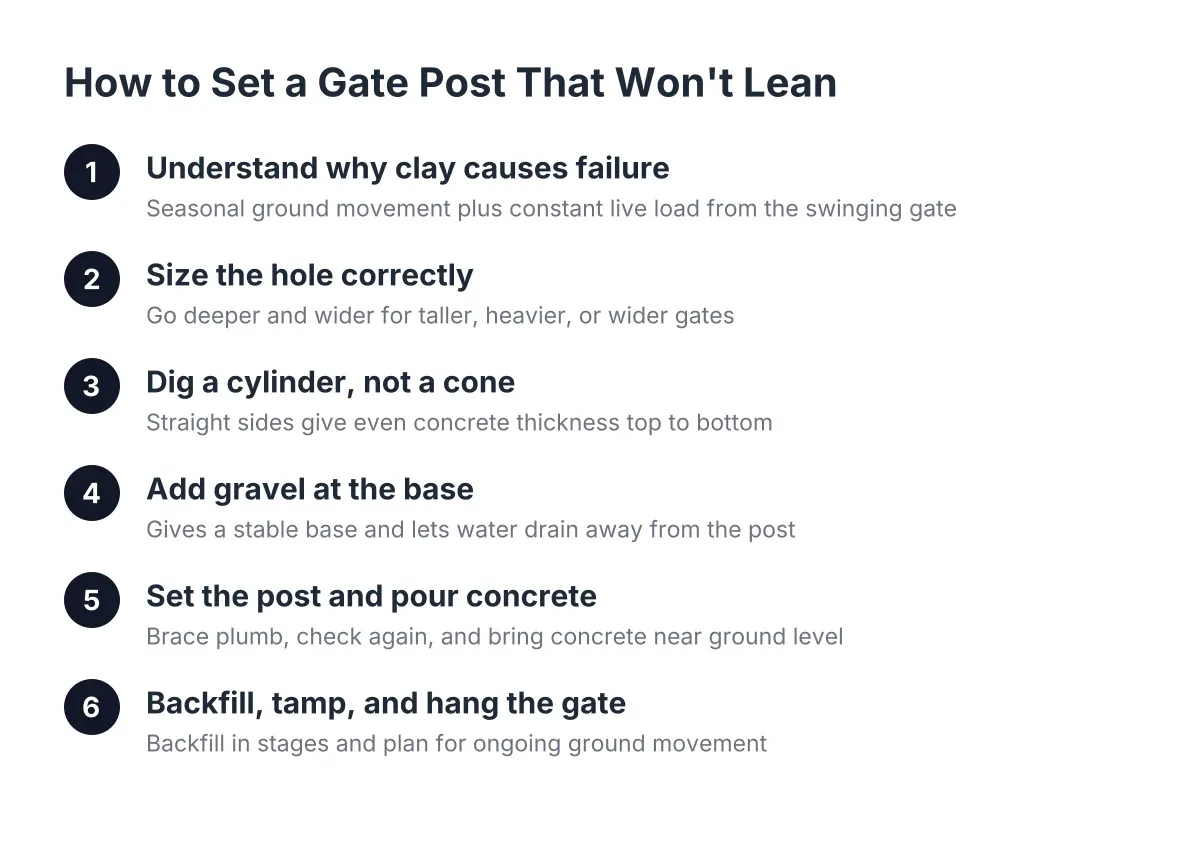
The hinge post is the foundation of the entire gate. It carries the full weight of the gate as a cantilevered load, all day, every day. On wood and vinyl fences, that usually means a deeper footing and more concrete than a standard line post gets. On heavy driveway gates, it often means steel. In difficult spots, like a gate butting against another fence or working around a tree, installers sometimes reinforce a vinyl post by sleeving it over a metal pipe so the plastic is not carrying the load alone.
When a hinge post is set like an ordinary fence post, the gate works fine at first. Then the post leans a few degrees, the gate drops, and the latch stops catching. Most "gate repair" calls are actually hinge post failures wearing a disguise.
The frame and the brace
A gate frame has to resist its own tendency to fold into a parallelogram. That is what bracing does. But bracing is direction-sensitive, and this is where many DIY gates go wrong. A flexible tension bar and a rigid anti-sag brace run in opposite directions, because a rigid brace installed the way a cable would run will twist under load and speed up the sag instead of stopping it. Installers also pre-rack a gate and temporarily fix the hinges to the rails before hanging, which holds the frame square during installation instead of hoping it lands square.
Vinyl gates have their own reinforcement trick. A channel insert inside the gate uprights gives the screws something solid to bite, which makes the frame far more resistant to pulling apart. Without it, a vinyl gate that a dog leans on daily loosens at the corners long before the fence around it shows any wear.
The latch is the pet-containment hardware
For a dog owner, the latch matters as much as the gate. A gravity latch a dog can nose open is not containment. Look for a latch that locks positively, mounts out of paw reach, and can accept a padlock or carabiner. Installers who think ahead set the latch striker before hanging the gate, because the striker position effectively self-aligns the gate during hanging. On ground that moves, placing the striker near the top of its adjustment range leaves room for the gate to settle and still catch.
Self-closing hinges deserve a mention here too. They do not defeat a clever dog, but they defeat a forgetful human, and forgetful humans let out more dogs than clever dogs let out themselves.
Ground clearance and the gap problem
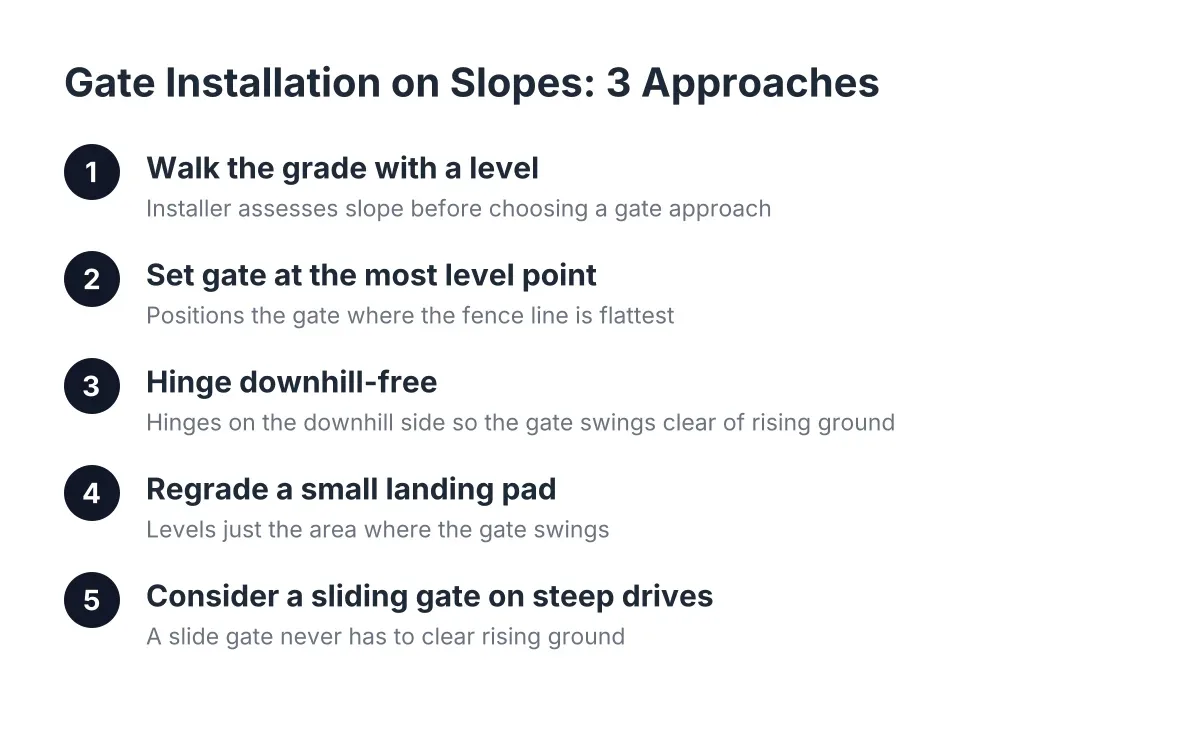
Ground clearance is where gates and dogs negotiate. The gate needs room to swing through the seasons; the dog needs that room to be too small to use. Good solutions depend on the site: a concrete mow strip under the gate, a threshold board, grading the swing path, or setting the gate at the high point of a sloped run. What does not work is guessing, because North Texas clay rises and falls with moisture, and a clearance that looks fine in August can be a tunnel entrance by March.
Why Mansfield Soil Makes Gate Installation for Dogs Harder
Gate installation for dogs in Mansfield fights a specific local enemy: expansive clay. North Texas clay soils swell when soaked by heavy seasonal rain and shrink hard during hot, dry summers. That movement stresses every post in a fence line, but it punishes hinge posts most, because they carry a live load while the ground under them changes shape.
The practical effects show up in predictable ways. A gate that latched perfectly in June scrapes in October. A driveway gate that swung clear all summer catches the ground after two weeks of rain. Additionally, a latch that lined up at installation sits a half inch low a year later. None of this means the work was bad; it means the installation has to anticipate movement. Deeper footings, correctly sized concrete, hardware with adjustment range, and latch strikers set with room to move are how a local fence company builds for the soil instead of against it.
Heat and occasional ice matter too. Wood gates swell, dry, and crack through Texas summers and freeze events, which is why hardware choice and finish care affect how long a wood or cedar gate stays square. Vinyl handles moisture better but needs proper internal reinforcement to handle heat flex. There is no material that ignores the climate; there are only installations that plan for it and ones that do not.
One permitting note worth knowing: the City of Mansfield exempts replacement or repair of an existing wood privacy fence from permitting when the work covers less than 50% of the total linear footage of fencing on the property, according to the City of Mansfield, Texas. Rules differ for new construction, other materials, and automated driveway gates, so confirm current 2026 requirements with the city or your installer before work starts.
What a Dog-Proof Gate Looks Like on Acreage
Large-lot owners face the same gate problem at a bigger scale. On one to ten acres, the perimeter fence might run hundreds of feet, but the dog still exits through the same place everyone else does: the driveway gate and the walk gates. A long cedar or metal perimeter run with a casually hung gate is a secure vault with the door propped open.
An automated driveway gate adds containment value beyond convenience. It closes itself, which solves the open-gate problem that defeats most rural containment. It controls who comes onto the property, which matters when gates get left open by visitors and delivery drivers. The market reflects how common this has become; the global automatic gate opening system market was estimated at $2.8 billion in 2025, according to Research and Markets. For acreage owners, the planning questions are swing versus slide, power supply to the gate location, battery backup, and safety sensors, all of which belong in the initial site visit rather than as afterthoughts.
However, automation adds failure modes a dog owner should think through. A sliding gate needs a clear track and a safe pinch zone. A swing gate on a slope needs clearance through its whole arc. And any automatic gate needs properly set safety devices so a slow-moving dog in the gate path triggers a stop. These are solvable problems, but they are design decisions, not accessories bolted on at the end.
DIY or Hire a Pro for Your Gate Project?
Whether to install a gate yourself or hire a professional comes down to the hinge post and the stakes. A homeowner can handle hardware swaps, latch upgrades, and adding a self-closing hinge to an existing gate that still hangs square. Setting a hinge post in Mansfield clay, building a braced frame, or installing anything motorized is work that rewards experience, and getting it wrong means a gate that fails exactly when your dog is motivated to find out.
A reasonable way to split the work:
- DIY-friendly: replacing a latch with a lockable one, adding self-closing hinges, installing a kick board or threshold to close a bottom gap, and routine tightening of hinge hardware.
- Lean professional: hanging a new gate in an existing opening, correcting a sagging gate where the post has moved, or converting a fence section into a new gated opening, since cutting a fence changes how the adjacent posts carry load.
- Hire a pro, full stop: new hinge posts in clay soil, wide or heavy driveway gates, any gate automation, and any gate tied into electrical or access control.
Warning signs that mean call now rather than later: a gate that no longer latches without lifting, a hinge post that visibly leans, concrete heaving at the post base, or a gap under the gate that grows after rain. Each of these points to foundation movement, and foundation problems compound. Fence repair on a gate that has pulled its post is cheaper early and expensive late.
On cost, be wary of any number quoted before someone sees the site. Gate pricing depends on gate width and weight, material, whether posts exist or must be set, slope and soil conditions, hardware quality, and automation. For broader context on fencing budgets, HomeAdvisor reports the average cost to install a fence is $23 per linear foot, with a typical range of $6 to $50 per linear foot depending on material and labor, but a gate is priced as a built assembly, not by the foot. A fair quote itemizes the posts, the gate, the hardware, and any automation separately so you can see what you are paying for.
Questions to Ask Before You Hire a Gate Installer
Ask a gate installation company three questions before you sign anything. First, how will you set the hinge post for this gate's weight and this soil? A good answer mentions depth, concrete, and clay movement specifically. Second, how do you handle the gap under the gate given my dog and my yard's slope? A good answer involves looking at the ground, not quoting a standard clearance. Third, what does the quote include, and what would be extra?
A trustworthy quote is specific. It names the gate material and width, the hinge and latch hardware, the post and footing approach, and the timeline. It separates the gate from the fence work. Furthermore, it does not promise a price over the phone for a site no one has seen, and it does not dodge the question of what happens if the ground shifts.
For a dog owner, add one more filter: does the installer ask about your dog? A contractor who asks the breed, size, and escape history before recommending a latch is planning a pet containment fence. One who does not is just hanging a gate.
Where to Go From Here
Walk out to your gate today and run a two-minute inspection. Lift the latch-side corner; if it moves more than a little, the gate is sagging or the post is leaning. Check the gap underneath against your dog's head width, because where the head fits, the dog follows. Flip the latch the way a paw would. Then look at the hinge post base for heaved or cracked concrete.
If any of that inspection worries you, or if you are planning a new wood fence, cedar privacy fence, vinyl fence, or a full perimeter with a driveway gate, talk to Mansfield TX Fence Pros. We will walk the site, explain what drives the price for your specific gate and ground conditions, and give you a clear, itemized estimate with no invented numbers and no pressure. Reach out to schedule a site visit, and bring the dog; the gate is being built for him anyway.
If you need gate installation, Mansfield TX Fence Pros can help.
Prefer to talk it through? Call (817) 383-9360 — a quick call is usually the fastest way to get a straight answer for your situation.