Gate Installation Permits in Mansfield: HOA Rules, Property Lines, and Easements
Before any posts go in the ground, sort out gate installation permits in Mansfield, your HOA's approval process, and where your property line actually sits. A gate permit and HOA approval upfront prevents costly mistakes—skipping that homework is how a new driveway gate ends up two feet into a utility easement, or how a quick gate replacement turns into a code compliance letter. This guide walks through the paperwork and property checks step by step, in the order a careful installer would handle them, so your project clears the city and the HOA before the first hole gets dug.
This matters whether you are planning a brand-new driveway gate or scrambling because a storm knocked your existing gate off its posts. Even a repair can trigger permit questions in Mansfield once the work gets big enough, so five minutes of checking up front beats weeks of back-and-forth later.
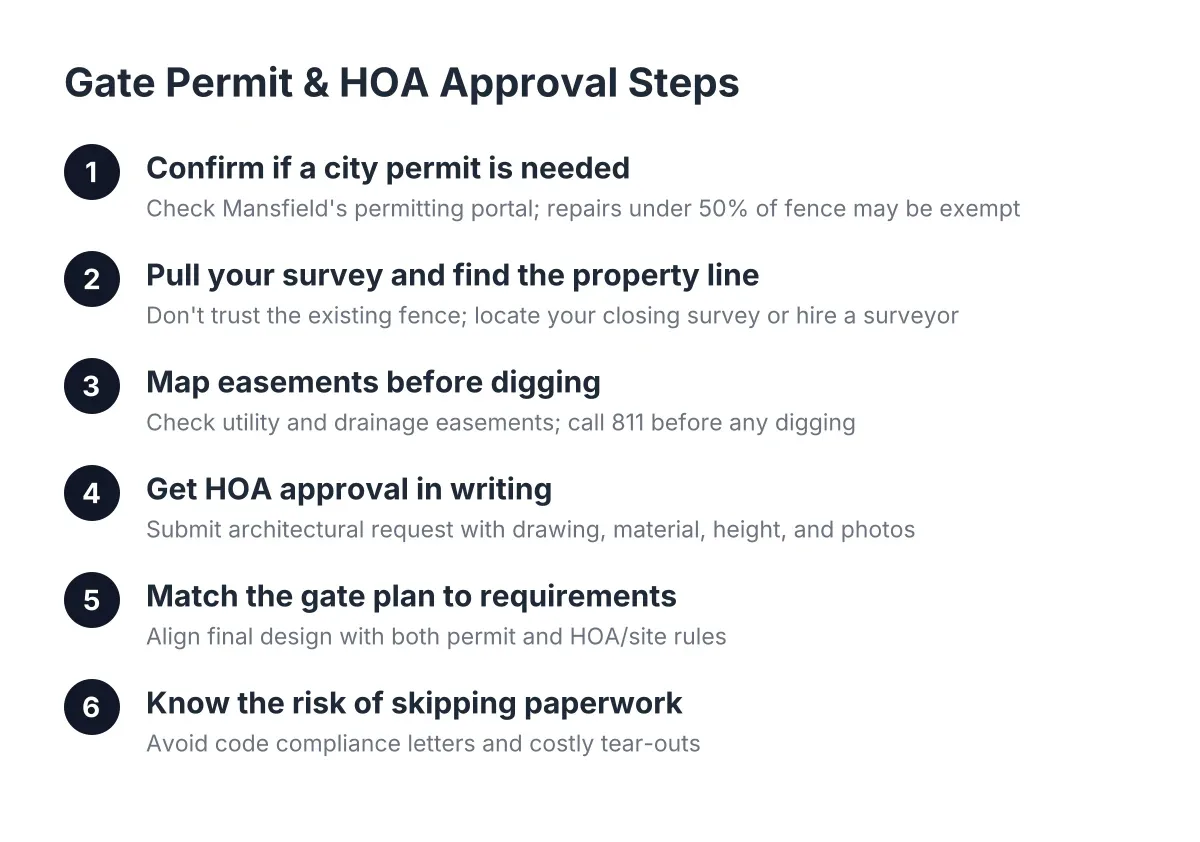
Step 1: Confirm Whether Your Gate Project Needs a City Permit
Start with the City of Mansfield's permitting office or its online permitting portal. Fence and gate work in Mansfield falls under the city's building code, and the answer depends on what you are doing: new installation, full replacement, or partial repair.
Here is the useful detail most homeowners miss. Mansfield's building code exempts replacement or repair of an existing wood privacy fence from permitting when the work covers less than 50% of the total linear footage of fencing on the property, according to the City of Mansfield, Texas. So if a storm took out one gate and a couple of panels on an otherwise sound cedar privacy fence, you may be under that threshold. If you are replacing most of the fence along with the gate, or building something new, expect to file.
A few situations almost always deserve a call to the city before you proceed:
- A new driveway gate where none existed before, especially an automatic one with electrical work
- A gate tied into a new concrete fence or masonry columns
- Any gate or fence section near a corner lot, where visibility rules at intersections apply
- Work along a drainage channel, creek, or street-facing side of the property
As of 2026, Mansfield handles much of this through online permitting, which makes the question cheap to ask. Asking costs you a few minutes. Guessing wrong can cost you a tear-out.
Step 2: Pull Your Survey and Find the Actual Property Line
Do not trust the existing fence to mark the boundary. Fences in neighborhoods that are 10 to 30 years old often sit inside, outside, or wandering across the true line, because someone decades ago eyeballed it. Your gate posts need to go on your property, full stop.
Find the survey from your closing documents; most Mansfield homeowners have one in the stack of paperwork from when they bought the house. It shows the lot dimensions, the easements, and the building lines. If you cannot find it, the title company that closed your purchase may have a copy, or you can hire a surveyor to re-mark the corners.
For example, suppose a homeowner near Walnut Creek wants to replace a failed walk gate and widen the opening for a trailer. The survey shows the side fence sits a foot inside the neighbor's line, not on it. Widening the opening toward the neighbor would mean building on land that is not theirs. Catching that on paper costs nothing. Catching it after the concrete cures means demolition and an awkward conversation over the fence.
Step 3: Map the Easements Before You Dig Post Holes
An easement is a strip of your lot that a utility, the city, or a drainage authority has the legal right to use. You own the land, but you cannot block their access. Most standard Mansfield lots have a utility easement along the rear line and sometimes the sides, and some have drainage easements that carry stormwater during heavy North Texas rains.
Gates and easements collide in two ways. First, a gate post set in a utility easement can be removed at your expense if the utility needs access, and they owe you nothing for the gate. Second, a solid gate or fence section across a drainage easement can dam water during a heavy rain event, which pushes water toward your foundation or your neighbor's yard.
Therefore, lay your survey next to your gate plan and check:
- Does any post, column, or concrete footing fall inside an easement?
- Does the gate swing or slide path cross one?
- If an automatic gate, does the trench for the power run cross an easement or a buried utility?
In addition, call 811 before any digging. Buried gas, water, and communication lines do not follow the easement lines exactly, and locating them is free.
Step 4: Get HOA Approval in Writing, Not in Passing
If your neighborhood has a homeowners association, its rules apply on top of the city's, and the HOA usually cares about things the city does not: gate height, style, color, material, and whether the finished side faces the street. A city permit does not override an HOA covenant, and the reverse is also true. You need both boxes checked when obtaining gate permit and HOA approval for your project.
Submit the HOA's architectural request form before you schedule installation. Include a simple drawing, the gate material (cedar, vinyl, or metal), the height, and a photo or spec sheet. Boards in Mansfield subdivisions commonly meet monthly, so build that wait into your timeline rather than discovering it after you have booked a crew.
However, if your gate is already broken and the property is unsecured, document the damage with photos and tell the HOA you are doing a like-for-like repair. Replacing a failed gate with the same style and material in the same location rarely draws objections, and most boards treat urgent repairs differently than new construction. Get that acknowledgment in writing, even if it is just an email.
Step 5: Match the Gate Plan to Permit and Site Requirements
With the paperwork mapped, finalize a gate design that satisfies all of it. This is where a fence company that works in Mansfield regularly earns its keep, because the design choices and the rules interact.
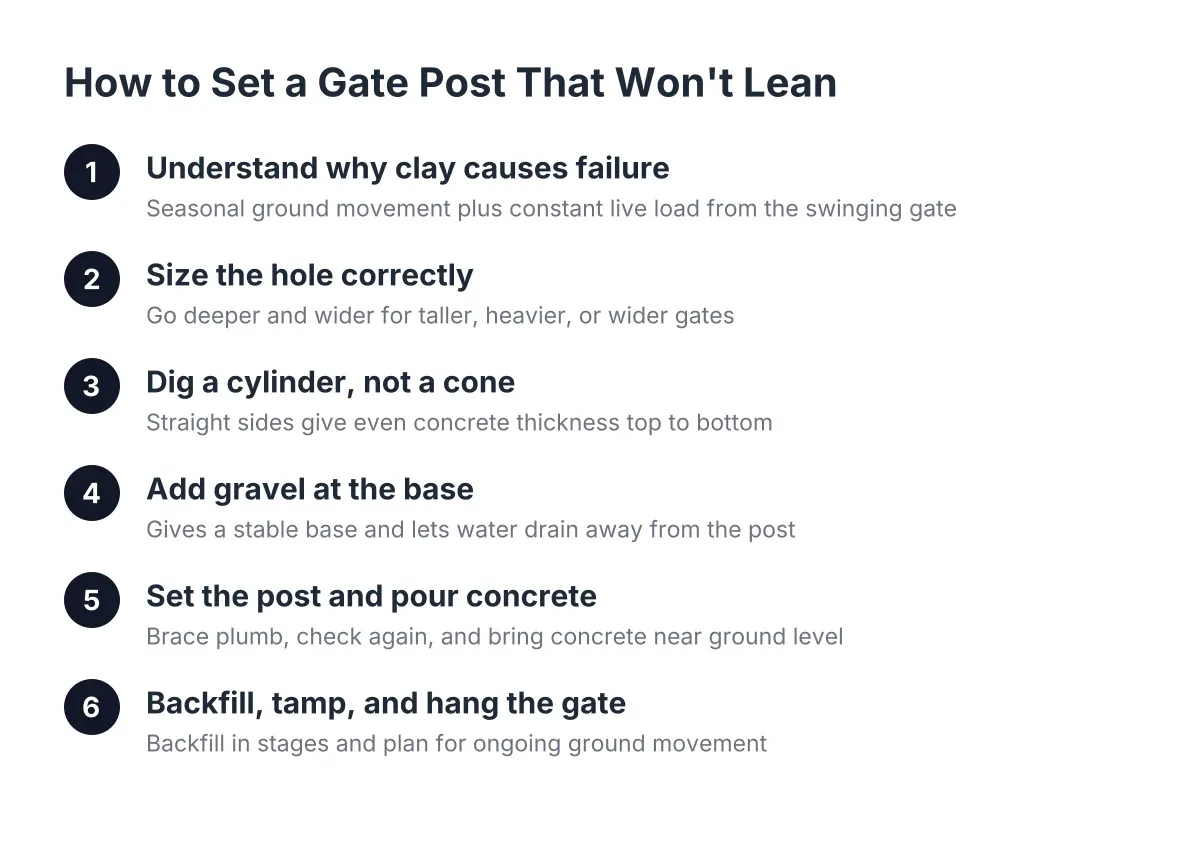
Expect a professional gate installation to include these items in scope: setting posts in concrete footings sized for the gate's weight, hanging and squaring the gate, installing the latch and hardware, and hauling off the old gate. Tamping dirt back into a post hole with no concrete is not an acceptable practice anywhere, and it fails fast in Mansfield's clay. Electrical work for an automatic opener, custom metal fabrication, and masonry columns are usually priced as extras, so confirm what your quote covers.
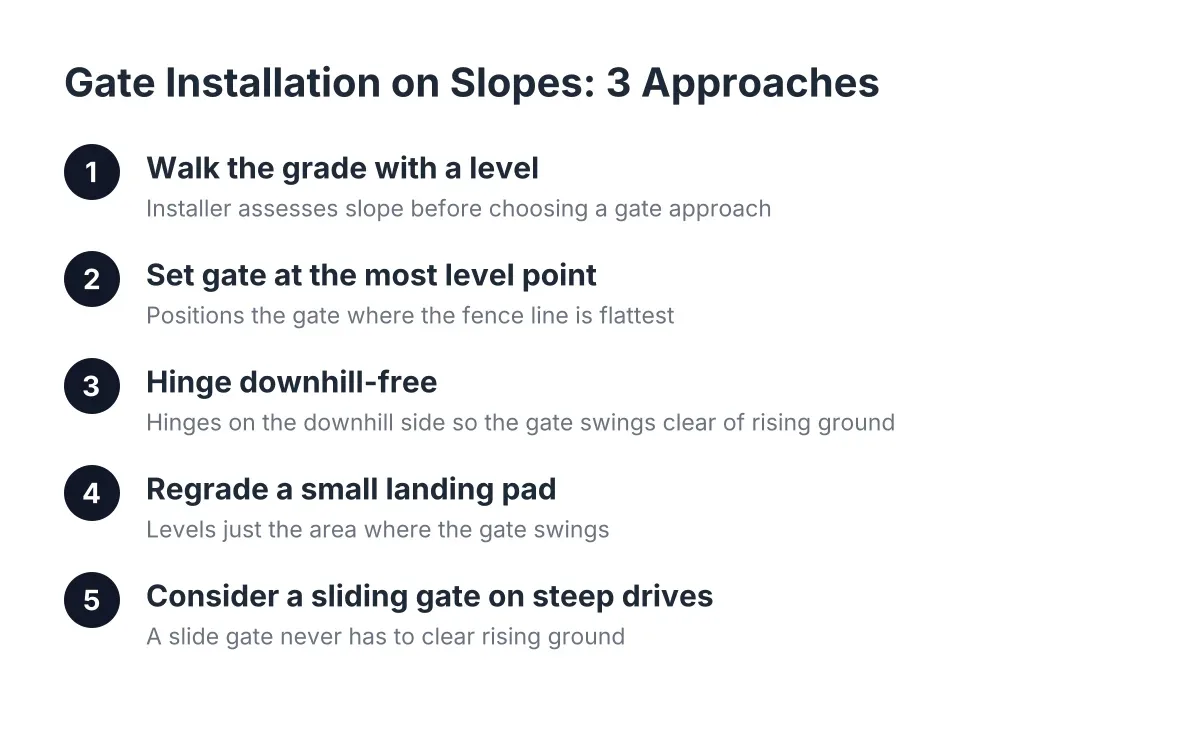
Local conditions shape the details. North Texas clay soils swell and shrink with seasonal moisture, which moves posts and throws gates out of alignment over time. A good installer plans for that movement, for example by positioning the latch hardware so the gate still catches cleanly as the ground shifts through wet and dry seasons. On a sloped driveway, the installer should run a string line across the post tops so the gate and fence follow the grade at a consistent height instead of stair-stepping awkwardly.
When Gate Permit and HOA Approval Affect Your Timeline
Permit review adds lead time, so sequence it honestly. A like-for-like gate repair under the city's exemption threshold can often happen as soon as materials and a crew are available. A new automatic driveway gate with an electrical permit, HOA review, and an easement question can add weeks before any work starts. Ask your installer who pulls the permit, you or them, and get that answer in writing on the quote.
On cost, be wary of anyone quoting a firm number before seeing the site. Price depends on the gate material and width, whether posts and footings need replacing, site access, slope, and whether an opener is involved. For general context, HomeAdvisor puts average fence installation at $23 per linear foot, with a typical range of $6 to $50 depending on material and labor; gates price differently because of hardware and hanging labor, but the same drivers apply. A fair quote itemizes the gate, posts, concrete, hardware, haul-off, and any permit fees separately.
Step 6: Know What Happens If You Skip the Paperwork
Installing a gate without required approvals in Mansfield invites three problems. Code compliance can require you to modify or remove the work, the HOA can fine you or demand removal under the covenants, and an unpermitted structure can surface as a problem when you sell the house and the buyer's inspector or title search flags it.
The easement risk is the most expensive version. A utility crew that needs access can remove your gate and footings without compensating you. In that scenario, you pay twice: once for the original installation and again for the rebuild in a compliant location.
One honest limitation: if your survey is old, your lot lines are disputed, or your gate plan sits close to an easement or a shared boundary, bring in a licensed surveyor before anyone digs. No fence company should guess at a boundary dispute, and a few hundred dollars of surveying is cheap insurance against building on the wrong side of a line.
Choosing an Installer Who Handles the Permit Side
Permits in Mansfield, HOA submissions, and easement checks are where installers separate themselves, so screen for it directly. Ask these three questions before you sign:
- Who handles the permit application and the 811 locate, you or me?
- Will you review my survey and flag any easement or property line issues before quoting?
- What exactly is in the quoted scope: posts, concrete footings, hardware, haul-off, and opener wiring?
An installer who answers all three plainly is one who has done this in Mansfield before. One who waves off the permit question is handing the risk to you.
If you are staring at a gate that is stuck open, leaning, or off its hinges, Mansfield TX Fence Pros can look at the site, tell you whether your repair falls under the city's exemption or needs a permit, and give you a clear, itemized estimate for gate installation or repair. Reach out to schedule a visit and get straight answers before any concrete gets poured.
Prefer to talk it through? Call (817) 383-9360 — a quick call is usually the fastest way to get a straight answer for your situation.