How Much Does Vinyl Fence Installation Cost?
How much does vinyl fence installation cost? The honest answer depends on three things more than anything else: how many linear feet of fence you need, the style and height of the vinyl panels you pick, and what your yard does to the work, from Mansfield's clay soil to slopes and old fence tear-out. Anyone who hands you one tidy number before seeing your property is guessing. This guide walks through what actually moves the price up or down, what a trustworthy quote should include, and how to get a real number for your own yard by the end.
What Drives the Cost of Vinyl Fence Installation
Vinyl pricing is not a mystery once you break it into its parts. Here are the factors that matter, in roughly the order they matter.
Fence Length
Fencing is priced by the linear foot, so the total footage of your property line is the single biggest driver. A backyard that shares two sides with neighbors who already have fence costs less to enclose than a corner lot where you own every foot. Walk your property line with a tape measure or pace it off. Even a rough footage number tells you which side of the budget you are on before you call anyone.
Panel Style and Height
A six-foot solid privacy fence uses more material than a four-foot picket or a ranch-rail style, and the price follows. Decorative touches raise it further: lattice tops, scalloped panels, and wood-grain textured vinyl all cost more than smooth white panels. If privacy is the goal, you are at the higher end of the material scale. If you just need to mark a boundary or contain a dog, a shorter or more open style trims the material bill.
Gates
Every gate adds cost, and a wide driveway gate adds more than a walk gate. Gates need their own hardware, latches, and sturdier posts, because a swinging gate puts constant stress on the post that holds it. In North Texas clay, that stress matters even more; a gate post that is not set right will sag as the soil shifts with the seasons. Count your gates before you ask for quotes. One walk gate is normal. Two gates plus a driveway gate is a meaningfully bigger job.
Site Conditions and Soil
Mansfield sits on clay soil that swells when it rains and shrinks in the summer heat. That movement stresses fence posts over time, so posts here need to be set deeper and with more care than in stable ground. Slopes, drainage paths, tree roots, and rocky spots all slow the crew down and raise the labor side of the bill. A flat, open, easy-access yard sits at the low end. A sloped lot with poor drainage and tight gate access sits at the high end.
Tear-Out and Haul-Away
If an old wood fence or chain link is coming down first, removal and disposal add labor and dump fees to the job. Rotten posts set in concrete are the slow part; each one has to be dug or broken out before the new post can go in. No existing fence means you skip this line entirely. If you have an old fence, ask whether removal is included in the quote or billed separately, because providers handle it differently.
Local Rules and Utilities
HOA requirements, city permits, and utility line locations can shape both the design and the cost. An HOA that requires a specific height or style takes some cheaper options off the table. Utility lines along your fence route may force hand-digging in spots, which takes longer than machine augering. Check your HOA rules and property survey before you get quotes, so the design you price is the design you can build.
Cost Factor Table
| Factor | Pushes the price down when… | Pushes it up when… |
|---|---|---|
| Fence length | You are fencing a short run or sharing sides with neighbors | You are enclosing a large or irregular lot by yourself |
| Panel style and height | You choose a shorter, simpler, open style | You want tall solid privacy panels, lattice tops, or textured vinyl |
| Gates | One standard walk gate | Multiple gates or a wide driveway gate with heavy hardware |
| Site conditions | The yard is flat, dry, and easy to access | Slopes, drainage issues, tree roots, or expansive clay complicate post setting |
| Tear-out | There is no existing fence to remove | An old fence with concrete-set posts must come out first |
| Rules and utilities | No HOA restrictions and clear digging routes | HOA style requirements, permits, or hand-digging near utility lines |
Getting a Real Estimate for Vinyl Fence Installation Costs
The fastest path to a real number is giving the estimator real information. Before you call a fence company, have these ready:
- Your footage. Pace off or measure the fence line. Close is good enough to start.
- Your style and height. Privacy, semi-private, or picket, and how tall.
- Gate count and sizes. Walk gates and any driveway gate.
- What is there now. Old fence to remove, slopes, drainage trouble spots, and anything blocking access.
- Your HOA rules, if you have them.
A good quote spells out the materials by name, the linear footage, the post depth and setting method, each gate as its own line, tear-out and haul-away if needed, and who handles utility locates. If a quote is just one number on a page, you cannot compare it to anything.
Estimates differ between providers for real reasons, not just markup. One company may price thicker-walled vinyl and deeper post settings for clay soil. Another may quote thinner panels and shallower posts that look cheaper on paper and cost you in repairs later. When two quotes are far apart, the difference is usually hiding in the materials and the post work. Ask.
If you are in Mansfield, our Vinyl Fence Installation in Mansfield, TX page covers how we approach vinyl fence installation for local conditions, and a site visit gets you a firm number for your actual yard.
Ways to Keep the Cost Down
You do not need gimmicks to lower the price. You need to control the factors you can control.
- Fence only what you need. If the goal is privacy on one side and a dog-safe boundary on the others, mix a tall privacy run with a shorter style elsewhere instead of pricing solid six-foot panels all the way around.
- Limit gates. Each gate is a cost line. If one well-placed walk gate covers your daily routine, skip the second.
- Choose standard styles. Smooth white panels in common heights cost less than textured, colored, or decorative options, and they hold up the same.
- Compare two or three itemized quotes. Not to grind the lowest bidder down, but to see where the quotes differ and ask why. The cheapest bid with shallow posts in clay soil is the expensive bid in five years.
- Handle prep yourself. Clearing brush, moving stored items off the fence line, and confirming HOA approval ahead of time cuts billable hours off the job.
Cost Questions People Ask
Is vinyl cheaper than a wood fence?
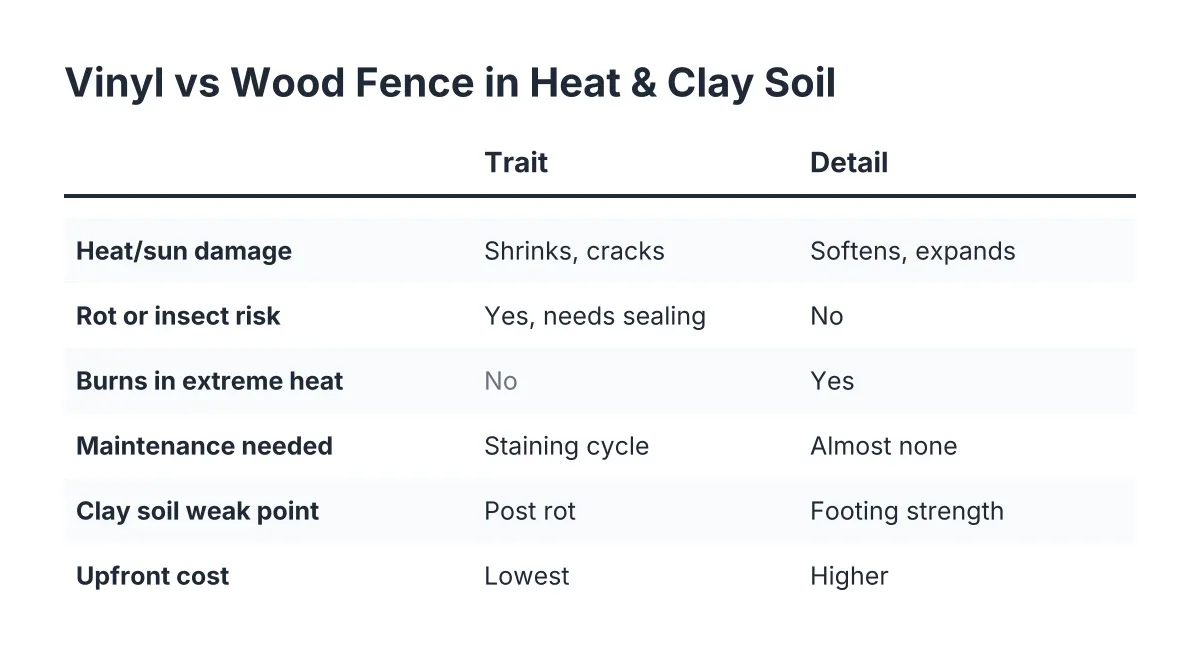
Usually not up front. Vinyl tends to cost more than a comparable wood fence on installation day, because the material itself costs more. The tradeoff is maintenance: vinyl does not need staining, sealing, or rot repair, so the gap narrows over the life of the fence. If you plan to stay in the home a long time, the lifetime cost picture often favors vinyl.
Why do vinyl fence quotes vary so much between companies?
Mostly because of what you cannot see in the finished fence. Panel thickness, post wall thickness, post depth, and how posts are set in clay soil all vary between providers, and each choice changes the price. Two quotes for the same footage can describe two different fences. An itemized quote lets you compare the actual work, not just the total.
Does a sloped yard raise the cost?
Yes. Slopes mean stepped or racked panels, more cuts, and more time setting each post at the right height, which raises labor. Drainage matters too; water moving along a fence line in heavy North Texas rain affects how posts should be set. An estimator who walks the yard can tell you how much your slope changes the job.
Can I save money by installing vinyl fence yourself?
You save labor, but you take on the hardest parts of the job: digging in dense clay, setting posts deep and plumb, and keeping panel lines straight over distance. Posts set too shallow in expansive soil lean within a few seasons, and fence repair on a leaning vinyl run often means resetting posts, not patching panels. If you do go DIY, put your effort into the post work. That is where the fence lives or dies.
The Bottom Line
The cost of vinyl fence installation comes down to footage, style, gates, and what your specific yard demands, which is why honest pricing starts with a look at your property, not a number pulled from a chart. Measure your fence line, decide on a style and gate count, and get two or three itemized quotes you can compare line by line. That is how you land on a real number you can budget around.
Prefer to talk it through? Call (817) 383-9360 — a quick call is usually the fastest way to get a straight answer for your situation.