DIY Wood Fence Repair vs. Hiring a Pro in Mansfield, TX: When Each Makes Sense
If your wood fence has a loose board, a sagging gate, or a post that leans a little more after every rain, you are deciding between two paths: grab tools this weekend or call a fence company. When weighing DIY vs professional fence repair, this guide walks you through the wood fence repair steps and tells you honestly where the DIY path stops making sense for homeowners in Mansfield, TX. If you have a dog who treats every gap like an open door, that line matters even more, because a half-fixed fence is an escape route waiting to be found.
Work through the steps in order. Each one ends with a clear signal for when to stay on the DIY track and when to hand the job to a pro.
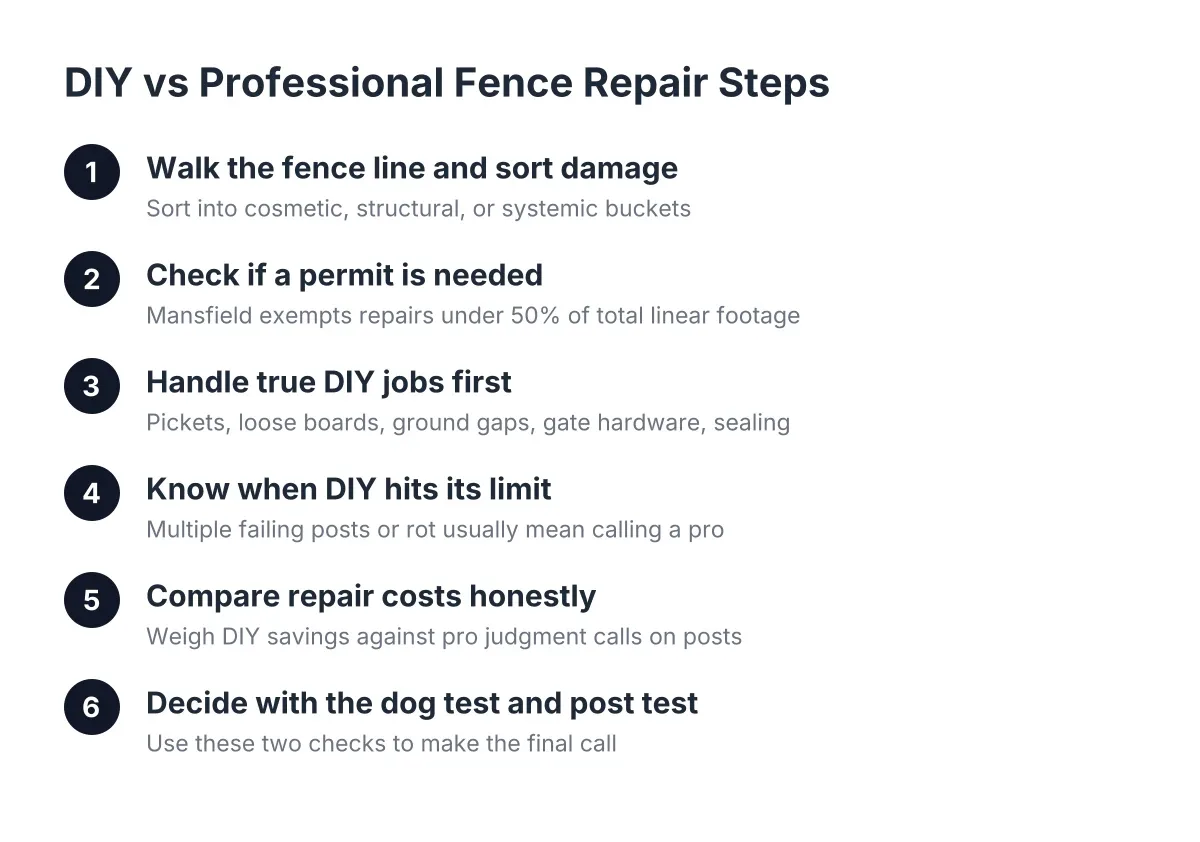
Step 1: Walk the Fence Line and Sort Damage Into Three Buckets
Before you buy a single board, walk the entire fence with a notepad. Push on every post. Look at the bottom of every picket. Open and close every gate twice.
Sort what you find into three buckets:
- Cosmetic: cracked or splintered pickets, popped nails, faded finish, one loose rail. These are solid DIY candidates.
- Structural: leaning posts, rot at ground level, a gate that no longer latches, multiple sagging sections. These sit on the fence between DIY and professional work.
- Systemic: several posts failing at once, long runs leaning the same direction, or widespread rot. This is pro territory, and sometimes replacement territory.
For dog owners, add a fourth check: get down at ground level and look for gaps under the fence, especially at gates and where the yard slopes. A gap that looks small to you is a project to a determined digger. Physical fences contain dogs better than electronic ones; a study by Starinsky, Lord, and Herron published in JAVMA found a 23% escape rate for physical fences versus 44% for electronic fences. The physical fence only earns that advantage when it has no exploitable gaps.
Step 2: Check Whether Your Repair Needs a Permit in Mansfield, TX
For most repairs, you will not need one. Mansfield's building code exempts replacement or repair of an existing wood privacy fence from permitting when the work covers less than 50% of the total linear footage of fencing on the property, according to the City of Mansfield, Texas. A few boards, a gate rebuild, or two or three posts almost always fall under that threshold.
However, if your walk-through in Step 1 revealed damage across more than half your fence, you are no longer repairing. You are rebuilding, and the permit question changes along with the budget. If you manage an HOA community with shared perimeter fencing, the math shifts again; phased repairs across common-area runs usually belong in a bid process with a contractor, not a volunteer weekend.
Step 3: Handle the True DIY Jobs First
Start with the repairs that take basic tools, one person, and an afternoon. These give you the biggest safety gain per dollar, especially for pet containment.
- Replace broken or splintered pickets. Pry off the damaged board, pull or cut the old nails, and fasten a new picket to the rails with exterior screws. Match the height of its neighbors.
- Refasten loose boards. Wind works nails loose over time. Drive exterior screws through the original nail holes or just beside them.
- Close ground gaps. Attach a treated kickboard, also called a rot board, horizontally along the bottom of the fence. It blocks digging and takes the ground contact instead of your pickets.
- Tighten gate hardware. Snug the hinge screws, adjust the latch, and add a self-closing hinge or spring if the gate ever gets left open. For a dog owner, an unlatched gate is the single most common escape point.
- Seal both sides. Staining or sealing both faces of the fence does more than improve looks; it extends the life of the wood and the return on the whole repair.
Suppose a homeowner in Mansfield just adopted a shepherd mix who dug out twice in the first month. In that scenario, a Saturday spent installing a rot board along the back run, replacing four cracked pickets, and adding a self-closing gate hinge closes every known exit, with no contractor needed.
Step 4: When DIY and Professional Fence Repair Meet Their Limits
The limit of DIY fence repair is the post. Posts carry the whole fence, and wood posts are prone to rotting, warping, and twisting over time, often while the pickets above them still look fine because they have been repainted and maintained. North Texas makes it worse: clay soil swells with seasonal rain and shrinks in summer heat, working posts loose and stressing gates year after year.
A single leaning post is a hard but doable DIY project if you are comfortable digging, bracing the fence, and mixing concrete. Here is the honest trade-off, though. The common instinct when a post rots at ground level is to rip out the post and its concrete footing and start over. That is heavy, slow work, and it is not always the most practical fix. An experienced installer will often cut the post above the rot and set a new steel post into the existing footing, which preserves the footing, costs less, and holds up better than a replacement wood post.
That kind of judgment call, which footings to save, which posts to cut versus pull, and how to keep an interim repair useful toward a future full rebuild, is where a fence repair pro earns the invoice. A smart interim post repair can keep the fence standing now while the money you spend still counts toward an eventual replacement with steel posts.
Call a professional rather than DIY when you see any of these:
- Two or more posts leaning or soft at ground level
- A gate post that has shifted, so the gate drags or will not latch
- Rot you can push a screwdriver into at the base of posts
- A whole section flattened by wind or a fallen limb
- Any repair where you would be improvising the structure rather than copying what is there
Step 5: Compare Repair Costs Honestly Before You Decide
What does wood fence repair cost compared to doing it yourself? DIY picket and hardware repairs cost you materials and a weekend; professional repair adds labor but buys structural judgment. As a reference point for the replacement end of the scale, HomeAdvisor puts the average cost to install a fence at about $23 per linear foot, with a typical range of $6 to $50 depending on material and labor. Repairs on a sound fence usually run well below replacing those same sections.
Several factors drive what a pro will quote for wood fence repair in Mansfield: how many posts are involved, whether footings can be reused, gate work, access to the fence line, and the condition of the surrounding sections. Be careful comparing bids on price alone. The cheapest quote often reflects cheaper construction practices and shorter expected life, which means paying again sooner. A fence rebuilt twice costs more than a fence repaired right once.
One more cost note for 2026: if your long-term plan is to move away from wood entirely, perhaps toward a vinyl fence for lower maintenance or a concrete fence for an HOA perimeter, factor material trends into timing. Concrete costs rose 6.7% year-over-year according to Gordian, which is one reason boards managing precast perimeter walls often phase that work across budget cycles.
Step 6: Decide Using the Dog Test and the Post Test
Here is the short version of the whole decision. Run two tests.
The dog test: If the damage creates a gap, a low section, or an unreliable gate latch, fix it now by whatever path is fastest. For a digger or a jumper, speed beats perfection; a same-day DIY rot board beats a repair scheduled for next month.
The post test: If the repair touches posts or footings, get a professional opinion before you dig. Post work done wrong fails again in the next wet season, and in Mansfield clay that season always comes.
Everything else, pickets, rails, hardware, stain, sits comfortably inside DIY fence repair for anyone with a drill and a free afternoon. A good local fence company should be willing to tell you which of your problems are weekend jobs and which are not; if an estimator pushes full replacement for a fence that needs three posts and a gate adjustment, ask them to walk you through why. Clear answers about cost drivers, not pressure, are what you should expect.
One limitation worth naming: no article can inspect your fence. If you are unsure whether a post is structurally sound, or if your fence borders a pool, a roadway, or shared HOA property, have a professional look before you or your dog test it the hard way.
If you need fence repair, Mansfield TX Fence Pros can help.
Prefer to talk it through? Call (817) 383-9360 — a quick call is usually the fastest way to get a straight answer for your situation.